

安東で静かな休息が流れる1泊2日の旅行コース
過去と現在が共存する魅力的な都市、安東での旅行コースです。扶龍台、松林食堂、河回別神仮面劇、竝山書院を巡りながら伝統文化を楽しみます。安東大長今蒸し鶏、観光コミュニティセンターここ、イサンル古宅を経て奉定寺、洛江水路公園、カチクモンチプ、安東布タウン、万休亭まで続く旅路で休息し、癒やしの時間を過ごします。
この場所はどうでしたか?
このコースは2日間の旅程サンプルです。そのまま保存するか、AI日程に拡張できます。

1日目
하회 솔밭식당 〉
경북 안동시 풍천면 하회장터에 위치한 솔밭식당은 안동찜닭, 고등어정식 등 안동 대표음식을 판매하고 있으며, 하회별신굿 탈놀이 공연장 및 하회마을 도보거리에 위치하고 있어 관광지 접근성이 좋다.
하회별신굿탈놀이 〉
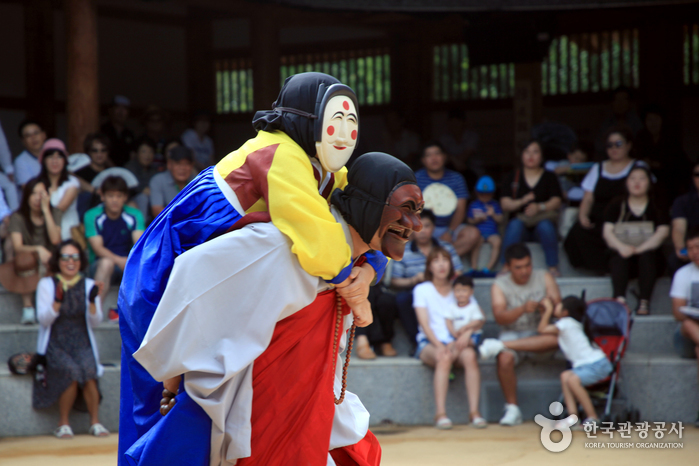
800년 이상 역사의 는 기득권층, 특권층, 일반 민중의 생활과 갈등을 꾸밈없이 드러낸다. 총 6개 마당의 공연에서 고려 중기부터 현대에 이르는 사회의 모순과 지배층의 권위를 날카롭게 풍자해 민중들의 답답함과 억울함을 해소한다. 시대를 뛰어 넘어 현재와 이어지고, 국내를 넘어 세계와 소통하는 축제의 장을 마련한다.
Byeongsan Seowon [UNESCO World Heritage] 〉
![Byeongsan Seowon [UNESCO World Heritage] 1](https://tong.visitkorea.or.kr/cms/resource/51/3575951_image2_1.jpg)
![Byeongsan Seowon [UNESCO World Heritage] 2](https://tong.visitkorea.or.kr/cms/resource/52/3575952_image2_1.jpg)
![Byeongsan Seowon [UNESCO World Heritage] 3](https://tong.visitkorea.or.kr/cms/resource/53/3575953_image2_1.jpg)
![Byeongsan Seowon [UNESCO World Heritage] 4](https://tong.visitkorea.or.kr/cms/resource/54/3575954_image2_1.jpg)
Byeongsan Seowon originated from Pungak Seodang (豊岳書堂), an educational institution in Pungsan, Andong dating back to the mid-Goryeo period. It was a place where local Confucian scholars gathered to study. During the late Goryeo period, when King Gongmin traveled through Pungsan amidst the Hong Geon-jeok rebellion, he was deeply moved to see the students devoted to learning despite the turmoil and generously gave many books and a grant of land to encourage them. After 200 years, as more houses and roads appeared nearby causing noise, the scholars sought a new location. Seoae Ryu Seong-ryong, after the death of his father and while residing in Hahoe, recommended Byeongsan as the best site. Following his advice, in 1575 (8th year of King Seonjo), the Seodang was relocated and renamed Byeongsan Seowon. In 1614 (6th year of King Gwanghae), disciples including Ubok Jeong Gyeong-se, Changseok Lee Jun, Dongni Kim Yun-an, and Jeongbong An Dam-su built Jondeoksa to commemorate Seoae's scholarship and virtue, enshrining his spirit tablet. The spirit tablet was moved in 1620 (12th year of Gwanghae) to Yeogang Seowon (dedicated to Toegye Yi Hwang), but was returned to Byeongsan in 1629 (7th year of King Injo). There were debates over whether to enshrine Seoae's tablet in both Yeogang and Byeongsan Seowons or in only one, but following the precedent of Zhu Xi, it was deemed acceptable to honor it in two seowons in the same area. In 1662 (3rd year of King Hyeonjong), the spirit tablet of Seoae’s third son, Suam Ryu Jin (1582–1635), was also enshrined. Byeongsan Seowon played a vital role in local education and produced many scholars. It was one of the 47 seowons that survived the 1868 order by Heungseon Daewongun to abolish seowons. (Source: Byeongsan Seowon website)
안동대장금찜닭 〉
경북 안동시 번영1길 구시장에 위치한 안동대장금찜닭은 대표메뉴인 찜닭과 더불어 양념/후라이트 치킨도 판매하고 있다. 푸짐한 양으로 관광객들이 많이 찾고 있으며, 전국 각지로 포장배달도 가능하다.
Tourism Community Center Yeogi 〉


Andong Tourism Community Center 'Yeogi' is located within Talchum Park, where the Talchum Festival is held. It offers a spacious area with ample seating and rents out space to tourism-related businesses and general citizens of Andong-si. Additionally, it operates an unmanned cafe, allowing visitors to enjoy various beverages without prior preparation. Visitors can also find tourism souvenirs from the Andong region, ranging from food products to daily necessities in diverse varieties.
2日目
이상루 고택 〉
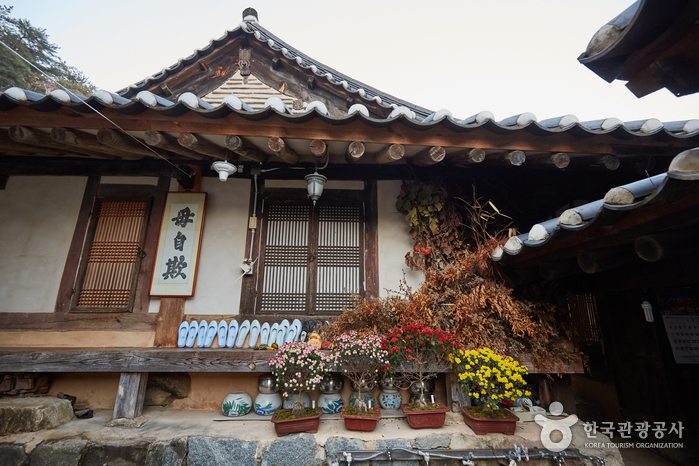
겨울에는 아궁이에 불 때고, 여름에는 모기장이나 텐트 치고 이상루에서 잘 수 있어 도시에서만 지낸 여행객들이 이색 경험을 할 수 있다. ''다도 체험'', ''탈춤 배우기'' 등 다양한 교육과 양반식 밥상을 경험할 수 있어, 아이들과 함께 전통문화를 체험하려는 가족이나, 한옥의 아름다움을 직접 경험하기 원하는 외국인들 모두에게 추천하는 곳이다.
Bongjeongsa Temple [UNESCO World Heritage] 〉
![Bongjeongsa Temple [UNESCO World Heritage] 1](https://tong.visitkorea.or.kr/cms/resource/94/3585194_image2_1.jpg)
![Bongjeongsa Temple [UNESCO World Heritage] 2](https://tong.visitkorea.or.kr/cms/resource/95/3585195_image2_1.jpg)
![Bongjeongsa Temple [UNESCO World Heritage] 3](https://tong.visitkorea.or.kr/cms/resource/97/3585197_image2_1.jpg)
![Bongjeongsa Temple [UNESCO World Heritage] 4](https://tong.visitkorea.or.kr/cms/resource/98/3585198_image2_1.jpg)
Cheondeungsan Bongjeongsa Temple is a good place not far or difficult to reach from where we live, allowing a brief escape from the busy city to enjoy peaceful leisure. It has the oldest wooden buildings in Korea and is a source of pride for all of us. Anyone visiting Bongjeongsa can forget all mental and physical fatigue and breathe in fresh air while hiking. It also continues the tradition of Korean mountain Buddhism, serving as a good training place. Bongjeongsa was founded in the 12th year of King Munmu’s reign in Silla (672) by Neungin, a disciple of Uisang Daesa. Cheondeungsan was originally called Daemangsan, but when Neungin was meditating in a rock cave there, a heavenly fairy impressed by his spiritual power lowered a lantern from the sky to brightly illuminate the cave, hence the name Cheondeungsan and the cave called Cheondeunggul. Later, Neungin, performing spiritual feats, folded a paper phoenix and flew it, stayed here, and opened the temple gate. Named Bongjeongsa, using the characters for phoenix (봉鳳) and stay (정停). The temple has been repaired six times since its founding and includes National Treasure No. 15 Geungnakjeon, National Treasure No. 311 Daeungjeon, Treasure No. 1614 rear mural, Treasure No. 1620 wooden seated statue of Avalokitesvara, Treasure No. 448 Hwaeomgangdang, Treasure No. 449 Gogeumdang, Deokhwiru, Muryanghaehoe, Samseonggak, a three-story stone pagoda, and subsidiary hermitages Yeongsanam, Jijoam, and Jungam. It is a beautiful temple visited by King Taejo and King Gongmin of Goryeo. (Source: Bongjeongsa)
Andongpo Village 〉


Andongpo Village continues the tradition of Andongpo fabric. Andongpo was used for Hwarangdo clothing in the Silla period and was renowned as a royal tribute fabric during the Joseon dynasty. Currently, at Geumso-ri Andongpo Village, efforts are being made to preserve the tradition of Andongpo despite difficulties caused by small-scale production and the import of cheap Chinese hemp. Andong City has designated Geumso-ri as an agricultural and fishing specialty complex to restore Andongpo's former fame, promoting the expansion of hemp cultivation and strategies to increase Andongpo's added value. The reason Andong Geumso-ri has maintained Andongpo for over 1,000 years is the well-draining sandy soil and climate suitable for hemp cultivation. Hemp is sown from late March to mid-April, harvested from late June to early July when it grows over 2 meters, then steamed, dried, and peeled to remove the bark. The inner bark is split and fibers are extracted to make hemp thread, which is soaked in starch and woven on a loom to produce Andongpo. After harvesting, weaving one piece of Andongpo takes 15–20 days, producing about 2,700 pieces annually. In leap months, demand rises due to the belief that making a shroud for elders then brings health, longevity, and offspring prosperity. Inside the village are the Andongpo Exhibition Hall showing the history, production methods, and products, and Bittarae Gilssam Village, which promotes Andongpo's preservation and development. In spring, a tulip festival is held in a large park drawing many visitors.
Manhyujeong 〉


Manhyujeong is the pavilion of Bobaekdang Kim Gyehaenggong. It was built in 1500 (6th year of Yeonsangun). The current building shows a modified form through restorations, with only parts reflecting late Joseon Dynasty style. Kim Gyehaeng was a civil official in the early Joseon period who held various positions. However, facing Yeonsangun's tyranny, he relinquished his office and returned to his hometown. He first built a small pavilion near Seolmot (present Sosan 2-ri), but due to its location by the road, he sought a quieter place and established this pavilion. It is located southeast, entering the mountain valley across the stream from Mukgye Seowon in Gilan-myeon, where a magnificent valley features a waterfall flowing over flat rocks. The structure has a dignified late Joseon style with a single-eaved, hipped-and-gabled roof; sharp eaves and inner walls enhance its pavilion charm. The size is three kan wide on the front and two kan deep on the side. The three front kan form an open veranda style with railings on three sides. The rear three kan include a wooden floor connected to the front veranda, with a high wooden panel at the back wall door opening. The two side kan have ondol rooms with traditional double-leaf doors facing forward and three-panel lattice doors facing the veranda. The fully opened front side forming the tolua veranda is uncommon and similar in layout to Yakkyejeong. Pillar tops have two-bracket candleholder-style decorations with lotus carvings on the window frames, showing detailed craftsmanship. The upper structure has a five-beam roof system with intermediate supports and bracket sets. Manhyujeong retains dignity unlike the more complicated late Joseon designs. ◎ Travel info meeting the charm of Hallyu – TV show features this Andong landmark in its 16th season. The quiet forest pavilion and the single-log bridge uniquely express the emotions of the cast.
このコースなら、ここで1泊すると移動が楽です
コース周辺で移動しやすく、満足度の高い宿を選びました


この都市の他のおすすめ日程
旅行レビュー
旅行のコツをシェアして、SNSも一緒にアピールしましょう。
会員登録して自分のチャンネルも一緒に紹介してもらう
(会員になると、マイページで設定した Instagram・YouTube・ブログのリンクが、あなたのコメントと一緒に表示されます。)
- ✔ あなたが書いたすべてのコメントに、SNSリンクが表示されます。
- ✔ コメントがベストに選ばれると、SNSリンクとともにホームページ上部にも掲載されます。
“「弘大近くに滞在して、夜のカフェ巡りをしました。街の夜景も雰囲気も最高でした。」”
ゲストとして投稿したコメントには、SNSリンクやプロフィールカードは表示されません。
旅行のひとことコメントを書く
この場所についてのちょっとしたコツや感想をシェアしてください。
ゲストとして、気軽にひとことコメントを残すこともできます。
ドラッグ&ドロップ、またはクリックして画像を追加(最大6枚)
まだレビューがありません。最初の感想を投稿してみましょう!