

南波浪路
“南波浪路”是一条从釜山广域市五六岛延伸至全罗南道海南郡土地尽头的1470公里探访路线。丽水被称为韩国的那不勒斯,三面环海,拥有400多个星罗棋布的小岛,构成了如画的多岛海。南波浪路丽水区间环绕这座美丽的海岸城市,连接了灵鷲山、丽水海洋公园、小湖洞动桥和朗岛,展现了丽水的浪漫风情。
这个地方怎么样?
这条路线是 4 天行程示例。你可以直接保存,或扩展为 AI 行程。

第1天
Heungguksa Temple 〉


Heungguksa Temple, located within Yeongchwi Mountain, was established to pray for the prosperity of the country, as its name suggests. It was founded with the wish that if the nation prospers, the temple will prosper, and if the temple prospers, so will the nation. Near the Yeosu National Industrial Complex, Heungguksa was founded by Bojo Guksa in 1195. Within the temple grounds are cultural assets including the Daeungjeon Hall, Wontongjeon Hall, and Palsangjeon Hall. The Daeungjeon Hall is notable for its latticed doors that can be fully opened. The rear mural painting of Daeungjeon is designated as a treasure, and the elegant Hong-gyo Bridge at the entrance of Heungguksa showcases its treasure value. Additionally, there are seven more treasures such as the Daeungjeon rear mural (Yeongsan Hoe Sangdo), Nosanabul suspension painting, Suwol Gwaneum painting, sixteen Arhats paintings, wooden Shakyamuni triad, Yeosu Heungguksa Temple bell, wooden Ksitigarbha triad, and a set of King of Hell statues along with associated relics. During the Imjin War, over 300 naval Buddhist warrior monks were stationed within the temple grounds, where they trained. From early April for about a month, the ridge extending behind Daeungjeon from Yeongchwibong to Jindallaebong is spectacular with clusters of azaleas bursting into bloom.
Mipyeong Bonghwasan Forest Bathing Site 〉
★4.6(7)


Mipyeong Bonghwasan Forest Bathing Site features an accessible walking trail, barefoot trail, and a children's forest, designed for the comfort and safety of all citizens including the elderly, disabled, pregnant women, and children. Visitors can enjoy forest bathing while walking and resting with mutual consideration for each other. The site includes a foot-washing area for barefoot walking, rest areas, restrooms, parking lots, as well as wooden bridges and a diversion dam.
第2天
Hallyeohaesang National Park 〉


Odongdo is an island in Yeosu-si that looks like an orchid tree leaf from afar and has been called Odongdo because of the abundant paulownia trees since the past. It is both the starting and ending point of Hallyeohaesang National Park. The island, with an area of 125,620.4m² (38,000 pyeong), is covered with a dense forest of 193 rare trees including camellia trees, Isaut bamboo, true camellia, hoopaek tree, zelkova, and privet. Especially, the camellia trees naturally growing here form a large colony, earning the island the nicknames Camellia Island or Flower Island of the Sea. Around 3,000 camellia trees cover the entire island, with flowers starting to bloom one or two at a time as early as October, allowing the sight of red flowers even in midwinter. About 30% bloom by mid-February, reaching full bloom by mid-March. The coast is rocky with high sea cliffs developed, creating spectacular rocky cliffs known as Conch Rock, Folding Screen Rock, Elephant Rock, Dragon Cave, and Roof Rock. Odongdo Lighthouse is located at the southern tip of the island. Vehicle access is restricted except for authorized vehicles. Transportation into the island from the entrance includes the Camellia Train, as well as ferry boats and motorboats. The Camellia Train operates from 9:30 AM to 5:50 PM on the way in and from 9:15 AM to 5:40 PM on the way out, running at 30-minute intervals except during lunch from 12:00 PM to 1:00 PM.
Gosodong Angel Mural Village 〉


Gosodong Mural Village is the oldest natural settlement in Yeosu, located on a hill with views of the sea, Dolsan Bridge, and Geobukseon Bridge. During the Imjin War, it was a historic site where Admiral Yi Sun-sin strategized and issued orders. In 2012, to coincide with the Yeosu Expo, Yeosu City and Gosodong residents collaborated to fill the walls with murals and utilized the geographical advantage to develop it as a tourist attraction. The route from Jinnamgwan to the Gosodong hill and Yeosu Marine Park stretches 1,004 meters, also known as Angel Mural Alley. The alley is divided into seven sections depicting stories related to the Expo theme, 'marine,' as well as Yeosu’s history, culture, scenery, and murals of Admiral Yi Sun-sin and the navy. There is a viewpoint rest area perfect for a short break. Inside the village is the Chungmugong Great Battle Monument Pavilion, a must-see attraction. It houses the Jwasuyeong Battle Monument (Tongje Yi Gong Navy Battle Monument, Treasure) commemorating Admiral Yi's victories and the Tarubi (Treasure) honoring his virtue. At the end of the mural alley lies Yeosu Marine Park, a favorite weekend outing spot for Yeosu citizens, especially beautiful at night.
第3天
Yi Sun-sin Square 〉

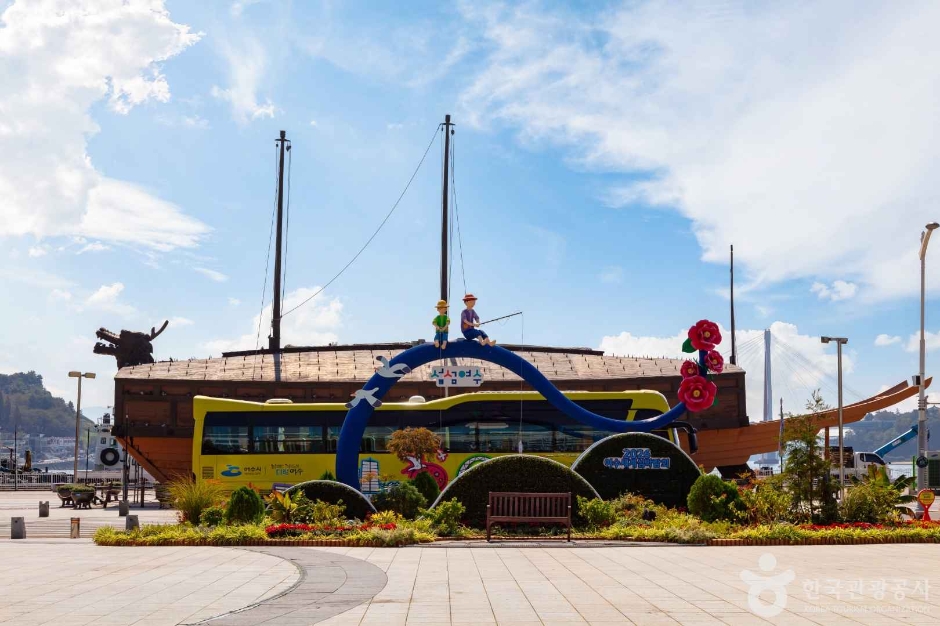


Yi Sun-sin Square in Jungang-dong, Yeosu-si, is a place with many attractions where visitors can see and feel historical sites, including materials about Admiral Yi Sun-sin who led victory in the Imjin War and information about the militia of that time. The square serves as the starting point of a historical and cultural tourism belt connected to nearby historic sites such as Jinnamgwan, where Admiral Yi Sun-sin planned operations and issued military orders. Every May, the oldest patriotic cultural festival in Korea, the Turtle Ship Festival, is held here. The most eye-catching structure is a nearly circular reproduction of the Turtle Ship. It is designed not only as an exterior model but also to be accessible inside. Entering the Turtle Ship interior, visitors can experience the dynamic scenes of naval soldiers and vivid moments of the Imjin War, along with simple interactive activities. Three Turtle Ships were built during the war at Jeollajwasuyeong, Bangdapjin, and Suncheonbu shipyards, with the current location of the Turtle Ship being the site of the Jeollajwasuyeong shipyard. On one side of Yi Sun-sin Square, there is a mural depicting Admiral Yi Sun-sin's life and the course of the Imjin War.
Sohodongdong Bridge 〉


Sohodongdong Bridge is a coastal deck walkway over the sea in Sohodong, where visitors can enjoy the beautiful night view of the night sea. It is 742m long and 3.5m wide. The origin of the name Sohodongdong Bridge is as follows: Since the Goryeo Dynasty, the Yeosu areas Ssangbongdong, Sohodong, and Hakdong were called Jangsaengpo. During the late Goryeo period, when Japanese pirates invaded Jangsaengpo, General Yu Tak went to battle to repel them, causing the pirates to retreat. The soldiers joyfully sang a song called "Jangsaengpogok," and there is a theory that Jangsaengpogok is the same as Dongdong, so the name was finalized as Sohodongdong Bridge. This bridge is a night view spot that is more beautiful at night than in the daytime. After sunset, lights installed on the bridge railings turn on along the coastal deck path, offering a view of the illuminated Seonsodaegyo Bridge. On weekends, busking performances are held and photo zones are set up, making it a great place for a night sea date in Yeosu. At the entrance of Sohodongdong Bridge, the public bicycle rental service "Yeosurang" is available for 1,000 won per day. ◎ Travel information to experience the charm of the Korean Wave - This location was used for filming episode 7 of the drama and is where characters Jinhong and Jinhee had a conversation. Sohodongdong Bridge is a 742m beach walkway and is one of the famous night sea view spots in Yeosu. After sunset, the lights installed along the deck turn on, allowing visitors to enjoy the atmospheric Yeosu night sea.
第4天
Nangdo 〉
★5.0(1)


The name Nangdo comes from the island's shape resembling a fox, using the character for wolf (狼). However, residents call it Yeosan Village, using the characters for beautiful (麗) and mountain (山) because all the mountains on Nangdo are scenic. Adjacent to it is Sado, famous for the world's longest dinosaur track fossil, and dinosaur footprints can also be found on the rocky shore of Nangdo. The island features low mountains and well-developed coastal trails offering splendid ocean views. It has a safe beach surrounded by wide breakwaters and a nearby campground, creating a natural resort where visitors can enjoy camping and water activities. A representative tourist attraction is Nangdo Beach.
Nangdo Port 〉
★4.1(67)


Nangdo is a small island located between Hwaryang-myeon, Yeosu-si, and Yeongnam-myeon, Goheung-gun. Previously, access to the island was only possible by boat, but after the opening of the land connection and island bridge linking the mainland and the island, accessibility has improved. Nangdo Port is a national fishing harbor that served as an emergency shelter for fishing boats during bad weather and was used as a forward base for fisheries. After the land connection, many tourists visit to buy Nangdo makgeolli, a local specialty, or to enjoy the beautiful nature of Nangdo Port. It is planned to be redeveloped into a tourist area with facilities such as a passenger pier and seafood market.


该城市的其他推荐行程
旅行评价
分享你的旅行小贴士,也让更多人看到你的社交账号。
注册成为会员,让更多人认识你的频道。
(成为会员后,在“我的页面”中设置 Instagram、YouTube、博客链接,我们会在你发表的每条评论旁一起展示。)
- ✔ 你发布的每一条评论旁都会显示你的社交账号链接。
- ✔ 如果你的评论被选为「最佳评论」,我们还会在首页顶部突出展示你的留言和社交账号。
““住在弘大附近,晚上去了一圈咖啡馆,城市夜景和氛围都太完美了。””
以访客身份发表的评论,不会显示任何社交账号链接或个人资料卡片
写下一条旅行短评
分享一条关于这个地点的小贴士吧。
或者以访客身份快速留下一个评论。
拖拽或点击添加图片(最多6张)
还没有任何评论,快来写下你的第一条感受吧!