

Byeonsanbando coastal road blue sea waves of time and restless nature
Byeonsanbando Coastal Road begins where it meets National Route 30 coastal road in Daehang-ri, Byeonsan-myeon, Buan-gun, Jeonbuk, after crossing the Saemangeum seawall. This 35.4km stretch runs along the winding coastline from Chaeseokgang to Gyeokpo Port and Gomso Port, making it a fantastic driving course. It features not only the vast blue sea but also quiet coastal villages, coastal cliffs uniquely shaped by tens of thousands of years of waves, mudflats that are a treasure trove of life, major spots of Byeonsanbando National Park's Oebyeonsan area, and the large and small beaches of Byeonsanbando.
※ You can zoom in on the map below to check detailed locations by course.
If courses overlap on the map, please zoom in to verify.
(Map zooming is possible using the mouse wheel or fingers at your desired location.)
How was this place?
This course is a sample 2-day itinerary. Save it as-is or expand it into an AI itinerary.

Day 1
Byeonsan Beach 〉

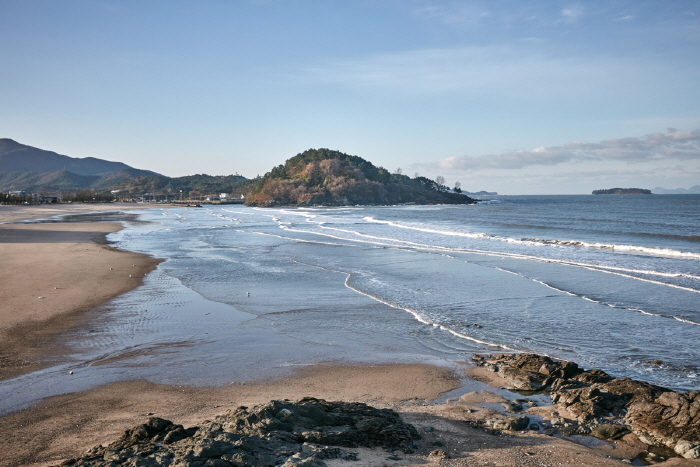


Byeonsan Beach is a representative beach of the west coast, known as 'Baeksacheong-song' Beach for its combination of white sand and green pine forests. It is one of the oldest beaches in Korea, opened in 1933. The gently sloping fine sandy beach stretches endlessly, and the water is relatively clear for a west coast beach. With an average depth of only 1 meter and warm water temperature, it offers excellent conditions for swimming and is a natural environment ideal for families. When tired of the heatwave, visitors can relax in the shade of the pine forest enjoying the sea breeze and camping. Every summer, during the beach's opening period, a free water playground is operated for children, gaining popularity among family visitors. Located right beside the beach, it features slides and fountains for children's water play. Lifeguards are on duty, and shade tents are set up where visitors can spread mats, have light snacks, or rest.
Gosapo Beach 〉


Gosapo Beach is located in Unsan-ri, Byeonsan-myeon, Buan-gun, featuring a white sandy beach about 2 km long and a wide, long pine forest about 300 m planted for wind protection, creating a magnificent view. It boasts the largest scale among the area's beaches. The water is clearer and cleaner than other beaches on the West Sea, and the sand is known to be fine and soft. The water temperature is moderate, making it a popular spot for family tourists who enjoy sea bathing in summer. The pine forest is suitable for resting in the shade or camping after enjoying the sea. It is also famous for its beautiful sunset, typical of West Sea beaches. Around the 15th day or the end of each lunar month, a sea path about 2 km long, called the modern-day miracle of Moses, opens from the beach to here. At this time, visitors can walk to the island and enjoy catching clams, octopus, sea cucumbers, and more. In front of the beach, there is a small island called Haseom, named for its resemblance to a shrimp. It is owned by the Wonbulgyo Foundation, and the general public must obtain prior permission to enter the island, but mudflat experiences to the island are allowed when the sea path opens.
Chaeseokgang 〉


This sedimentary rock, formed about 70 million years ago from the Cretaceous period of the Mesozoic era under marine erosion, consists of the Gyeokpori Formation including conglomerate over conglomerate, alternating layers of conglomerate and sandstone, sandstone and mudstone, shale, and volcanic ash. This sedimentary environment suggests this area was once a deep lake where volcanic ejecta settled on the lakebed. Faults, folds, intrusion structures, and wave-cut platforms are also easily observed in these cliffs, making it excellent for studying topography and geology. Wave erosion has created sea cliffs, flat wave-cut platforms, and sea caves. The bottom of Chaeseokgang features potholes formed through crust and wave action, along with tidal pools formed by seawater trapped during high tide. ◎ Travel info to experience the charm of cold currents - The drama begins where Ban Ji-eum, carrying memories of a past life like waves, slowly walks at the towering cliffs and sea caves. The sedimentary rock formed since about 70 million years ago during the Cretaceous period seems to reflect the long years she has endured.
Day 2
Sangnok Beach 〉


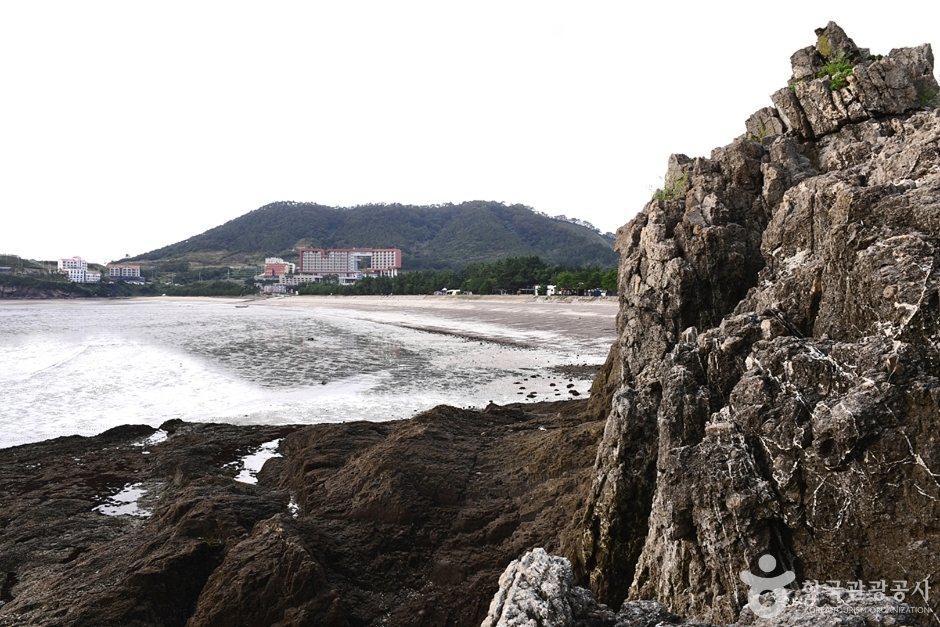
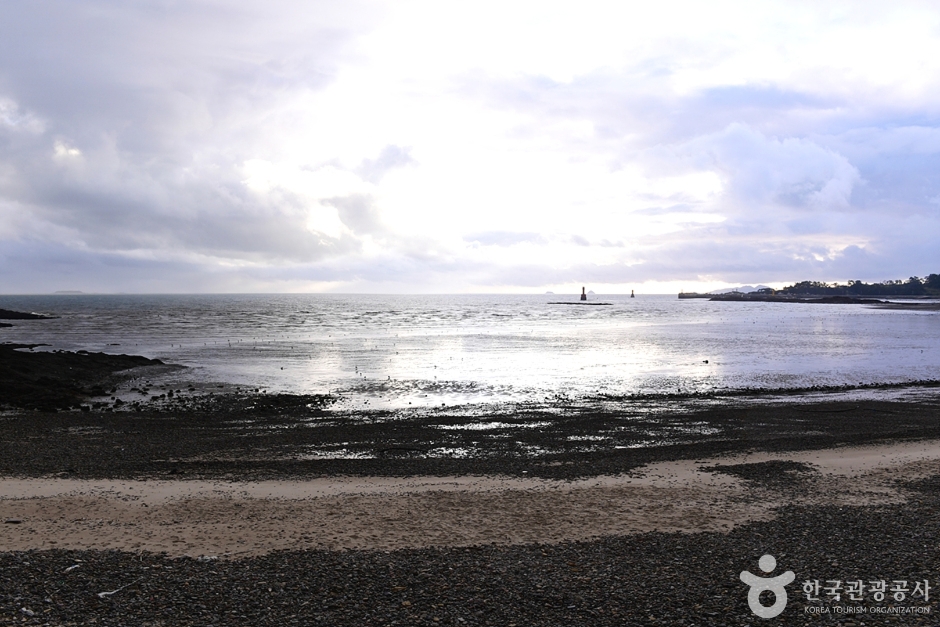
Sangnok Beach is located in Unpo Village, Docheong-ri, Byeonsan-myeon, Buan-gun. Since its opening in 1988, it was initially only available to public officials and their families but is now open to the general public. Behind the sandy beach is a windbreak forest made of pine trees and scattered strange rock formations. The water is shallow, and the sand is clean. In a 1999 water quality test, it received first-grade status. Around the beach, there are well-equipped convenience facilities such as restaurants, a swimming pool, volleyball court, shower room, cooking area, and camping site. Additionally, a natural camping site in the pleasant pine forest operates for a fee. It is located in section 4 of the West Sea Trail 46 course and Buan Byeonsan Masil Trail Coastal 8 course, covering 'Gyeokpo Port~Gung Port~Sol Island.' Starting from Gyeokpo Port, passing the Jeolla Left Naval Command set, Gung Port, and reaching Nonghyup Byeonsan Training Center, Sangnok Beach is visible. The beach is about the midpoint of the approximately 5 km Masil Trail, making it an ideal spot for round-trip trekking toward Gyeokpo Port or Sol Island.
Gomso Port 〉


Gomso Port is located around Jinseo-ri, Jinseo-myeon, Buan-gun. It is the second largest port after Gunsan Port. When Julpo Port was closed due to sedimentation, in 1938, a seawall was built linking Gom Island in front of Jinseo-ri with Beom Island and Yeondong to the east, and Ggachi Island and Jakdo-ri to the west, creating this harbor. It is a forward base for West Sea fisheries. The name Gomso comes from two islands shaped like bears and the deep pools in front of these islands, with a proverb saying "Gomso is deep like a bear's pond." Ferries operate to Wido. Gomso Port is active, with about 130 fishing vessels entering daily. Surrounding Gomso Port are large-scale salt fields, the largest salted seafood market in Korea called Gomso Jeotgal Market, a seafood market, and a dried seafood market, attracting many tourists. Salt fields literally mean 'fields where salt is made.' Salt is made by drying seawater with wind and sunlight in salt fields, called natural solar salt, distinct from factory-made chemical salt. Salt production involves reservoirs, evaporation ponds, and crystallization ponds. Seawater is stored in reservoirs during high tide, then sent to evaporation ponds through long channels, containing 5% salinity. After 7–8 days of evaporation there, water moves to crystallization ponds (salt fields with jar-piece tiles). Mixing about 30kg of existing salt with evaporated water creates foam; bubbles attach to evaporated alkali and sink. This brine has about 25% salinity. After 2–3 days drying by wind and sun in crystallization ponds, salt forms, which is raked and stored. The natural solar salt made here creates the famous Gomso salted seafood, widely acclaimed nationwide with many visitors eager to purchase it.
For this course, these stays make an easy overnight stop
Selected for easy access around the course and strong guest ratings


More recommended itineraries in this city
Travel Reviews
Share your travel tips & promote your social media.
Sign up to feature your channel.
(As a member, you can add your Instagram, YouTube, and blog links in My Page, and we’ll show them with every comment you write.)
- ✔ Your social media links appear with every comment you write.
- ✔ If your comment is chosen as a Best Comment, it’s also featured on our home page with your social media links.
““Stayed near Hongdae and did a night café tour. Perfect city views and vibes.””
Guest comments do not display social media links or profile cards.
Leave a traveler review
Share a short tip about this place.
Or leave a quick comment as a guest.
Drag & drop or click to add images (up to 6)
No reviews yet. Be the first to share your experience!