

Haeparang trail Busan Ulsan section
Haeparang-gil is the longest walking trail in South Korea, totaling 750 km, starting from Oryukdo in Busan. Walking along Haeparang-gil, which connects coastal roads, forest paths, and village trails, you will be filled with beautiful coastal scenery. Following a path imbued with the wishes of sea people, you will encounter Haedong Yonggungsa, the temple where the sun rises first. There is also Dongbaekseom, where camellia flowers turn red in midwinter, and Ganjeolgot, where you can see the earliest sunrise.
How was this place?
This course is a sample 4-day itinerary. Save it as-is or expand it into an AI itinerary.
Day 1
Oryukdo 〉
★4.5(187)


Oryukdo consists of six rocky islets rising from the rough waves off Yongho-dong, divided from the closest to land as Bangpae Island, Sol Island, Suri Island, Songgot Island, Gul Island, and Lighthouse Island. Oryukdo was a small peninsula connected to the land until about 120,000 years ago, but over time, strong wave erosion separated it from the mainland. This is also evident in the geological similarity between Seungdumal on land and Bangpae and Sol Islands. The name Oryukdo comes from a 1740 record in Dongnae-buji Sancheonjo stating, "Oryukdo is east of Jeolyeongdo. Its peaks and mountains stand in the sea side by side, appearing as six peaks from the east and five from the west, hence the name." The island names reflect this: Bangpae Island, closest to land, shelters from strong winds and waves; Sol Island has wild pine trees on its top; Suri Island attracted eagles due to its glare at seagulls; Songgot Island is small and pointed; Gul Island, the largest, has a large cave with water enough for one person’s drink; and Lighthouse Island, farthest, was once called Field Island but renamed after a lighthouse was built and is the only inhabited island. The currents near Oryukdo are very strong, making navigation dangerous; historically, sailors offered rice to sea gods and held Yongshin rituals for safe passage. Oryukdo is the gateway of South Korea and the symbol of Busan Port, as all vessels entering or leaving must pass by here. (Source: Busan Namgu Office Culture & Tourism)
Haeundae Dongbaek Island 〉
★4.6(268)


Dongbaek Island has been connected to the land through sedimentation over a long period, but it is still called Dongbaek Island, reminiscent of its ancient geography. Many poets and scholars, including Choi Chi-won, visited this place where the sea and forest harmonize to enjoy its scenic beauty and passed down their impressions through poetry. A walking trail surrounds Dongbaek Island, attracting continuous visitors. There are various humanistic traces from past to present, including Choi Chi-won's Haeundae inscriptions, statues, and poetry monuments, the mermaid statue from the Princess Hwangok legend, and Nurimaru APEC House. In addition, the views of Busan from Dongbaek Island are impressive, with the coastline of Mipo across, Dalmaji Hill, Gwangandaegyo Bridge spanning the sea and sky, and Oryukdo, a symbol of the Busan sea, all visible at once. As its name suggests, camellia flowers bloomed so thickly here that horses were once kicked by falling blossoms; even now, from winter to spring, flower buds form and bright red flowers fall whole, enhancing its charm.
Day 2
Haeundae Beach 〉
★4.6(2.6k)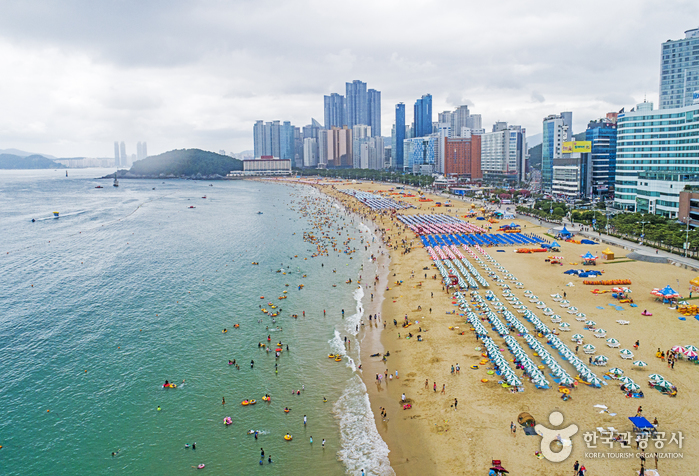


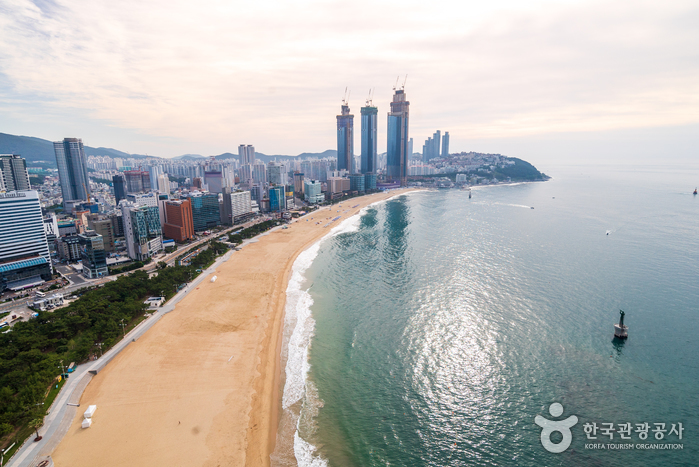
Haeundae Beach boasts a wide white sandy shore and beautiful coastline, offering ideal conditions for swimming with shallow waters and gentle waves. It is the most iconic spot representing Busan, often the first place that comes to mind when thinking of the city, and it attracts the largest crowds in the country, especially during the summer vacation season. The coastline is lined with large and small buildings and luxury hotels, giving the beach a modern and sophisticated atmosphere. It is bustling with youthful energy year-round, not only in summer, and is well-known among international tourists. Every year, the beach hosts a full moon festival on the first full moon day of the lunar new year. Additionally, the annual Polar Bear Swimming Contest held in winter has established itself as a representative winter festival. Other events include sand art exhibitions and the Busan Sea Festival. Nearby attractions around the beach include Dongbaekseom Island, Oryukdo, an aquarium, yacht races, and Bexco Dalmaji Hill. ◎ Travel information to experience the charm of Hallyu - The drama features scenes where Nam-soon and her Mongolian mother create the word 'sea' in shells on the sand and enjoy taking pictures together.
Cheongsapo 〉
★4.5(688)


If you follow the Haeundae Dalmaji Hill towards Songjeong, the place visible down to the right is Cheongsapo. Between Busan's Haeundae and Songjeong, there are three small harbors lined up along the coast. Along with Gudeokpo and Mipo, Cheongsapo is one of those small harbors. Cheongsapo is famous for producing very high-quality seaweed, and the sunrise here is already well known for its beauty. The rocky shore around Cheongsapo is always bustling with anglers who come to fish, especially in the fall when mackerel is in season, attracting even more people. Along the coast runs the Donghae Nambu Line, where trains occasionally blow their whistles, making the quiet rural village scenery even more picturesque. This railway is one of only two coastal railways in the country and is well known as a filming location for the movie "Blue Warning" (파랑주의보), making it even more beloved. Also, at one side of the harbor, there are restaurants and sashimi shops lined up, where enjoying freshly caught seafood with the peaceful harbor as a backdrop is one of the great pleasures. The original name of Cheongsapo was Cheongsa, meaning "blue snake." According to a legend related to the name, a devoted couple once lived in this village; when the husband drowned at sea while fishing, the wife waited every day on the coastal rocks. Moved by her sorrow, the Dragon King sent a blue snake to the East Sea Dragon Palace, where she was reunited with her deceased husband. However, as having the word "snake" in the village name was considered undesirable, it was recently renamed to mean "harbor of blue sand."
Day 3
Haedong Yonggungsa Temple 〉
★4.4(26k)
Haedong Yonggungsa Temple was founded in 1376 by Naong Daesa, the royal teacher of King Gongmin, and is one of the Three Great Gwaneum Sacred Sites in Korea. It harmoniously combines the sea, dragons, and the Great Gwaneum Buddha, embodying deep religious meaning. It is famous as a place where anyone who sincerely prays will receive a divine dream and have one wish granted. Destroyed during the Japanese invasions of Korea, it was rebuilt in the early 1930s by Ungang of Tongdosa. In 1974, Monk Jeongam became the temple head, vowed to restore it as a Gwaneum site, and performed a 100-day prayer; after dreaming of Gwanseum Bosal dressed in white riding a dragon and ascending, he renamed the temple Haedong Yonggungsa. Existing buildings include the Daeungjeon, Gulbeopdang, Yongwangdang (Yonggungdan), Beomjonggak, and temple lodgings. The Gulbeopdang next to Daeungjeon, also called Mireukjeon, enshrines a seated Maitreya stone Buddha since its founding, known as Deuknambul, believed to grant offspring to those without descendants if they pray. In front of Daeungjeon stands a four-lion stone pagoda.
Ganjeolgot 〉


Located in Ulju-gun, Ulsan, Ganjeolgot is the place where the sun rises first on the Korean Peninsula, making it a representative spot visited by many every New Year's Day to witness the sunrise. Here, the sun rises about 1 minute earlier than at Pohang Homigot and about 5 minutes earlier than at Gangneung Jeongdongjin. One of Ganjeolgot's symbols, the Ganjeolgot Lighthouse, is a historic lighthouse built in the 1920s during the Japanese colonial period. It is now loved as a great walking course and photo spot as it blends with the surrounding park. The white lighthouse standing tall against the blue sea makes the scenery of Ganjeolgot even more impressive. Another special attraction here is the world's largest wish mailbox. Postcards put in it are actually delivered anywhere nationwide, and free postcards are distributed at Ganjeolgot Haeolje (Uljugun specialty product store), offering tourists precious memories. The Ganjeolgot area boasts beauty throughout the four seasons with rapeseed flower fields, peculiar rocks, and dense pine forests. Nearby attractions include Jinha Beach, the most crowded summer beach in Ulsan, Seosaengpo Waeseong, Nasabongsudae, and Onyandonggi Village, making for a variety of sights to enjoy. The wide-open horizon, early morning sunlight, and tranquil lighthouse scenery combined make Ganjeolgot a travel destination everyone should visit at least once.
Day 4
Jangsaengpo Whale Culture Village 〉


Created in 2015, Whale Culture Village reproduces the appearance of the old Jangsaengpo whaling fishing village, offering a park with various themes and stories including Whale Plaza, Old Jangsaengpo Village, Prehistoric Whale Yard, Whale Sculpture Garden, and Aquatic Botanical Garden. It features unique experience spaces where visitors can encounter and learn about various whales represented in life-size whale forms. In addition, there are storytelling photo zones covering themes such as interaction and coexistence with whales, as well as outdoor learning spaces where visitors can experience prehistoric whale history culture including the Bangudae Petroglyphs and whaling murals. This is a space where diverse learning and play activities are possible.
Ulju Daegok-ri Bangudae Petroglyphs [UNESCO World Heritage] 〉
![Ulju Daegok-ri Bangudae Petroglyphs [UNESCO World Heritage] 1](https://tong.visitkorea.or.kr/cms/resource/84/3507484_image2_1.jpg)
![Ulju Daegok-ri Bangudae Petroglyphs [UNESCO World Heritage] 2](https://tong.visitkorea.or.kr/cms/resource/86/3507486_image2_1.jpg)
![Ulju Daegok-ri Bangudae Petroglyphs [UNESCO World Heritage] 3](https://tong.visitkorea.or.kr/cms/resource/88/3507488_image2_1.jpg)
![Ulju Daegok-ri Bangudae Petroglyphs [UNESCO World Heritage] 4](https://tong.visitkorea.or.kr/cms/resource/89/3507489_image2_1.jpg)
In Daegok-ri, Eonyang-eup, Ulju-gun, Ulsan, there is the scenic Bangudae, where a ridge of Yeongosan extends down and ends abruptly in striking rock formations, resembling the shape of a turtle lying flat, hence the name Bangudae (盤龜臺). The clear waters flowing down from Cheonjeon Valley in Doodong-myeon gather here to form a lakeside, celebrated as a place of exceptional beauty. Since ancient times, poets and scholars from various regions visited to enjoy the scenery through poetry. Petroglyphs are pictures carved into rocks by prehistoric people, depicting various events from their daily lives. Typically made on large rocks or sacred sites, these places were likely gathering spots for rituals. The Ulju Daegok-ri Bangudae Petroglyphs are located at the so-called "Geonneo Gakdan," a tributary of the Taehwa River called Daegokcheon, with the main rock face measuring 10m wide and 3m high. Numerous images are also found on surrounding rocks, totaling about ten sites with petroglyphs. These carvings are believed to have been made over multiple periods from the Neolithic era, showing stylistic differences by era. They are divided into two techniques: the area-chiseling method, where entire interiors are carved out, and the outline-chiseling method, where only contours are engraved. The depicted subjects include sea animals, land animals, humans, and tools. Sea animals include whales, seals, and turtles; land animals include deer, tigers, wild boars, and dogs. Human figures appear as faces only, standing frontally or sideways, and riding boats. Tools depicted include boats, fences, nets, harpoons, and crossbow-like objects. These images are thought to represent prehistoric hunting activities, carved with the hope for successful hunts and abundant game. Expressing animals and hunting scenes vividly and realistically, these petroglyphs serve as both hunting and religious art, offering invaluable insight into prehistoric life and customs. As the earliest whale hunting record and the first prehistoric art on the Korean Peninsula, the Bangudae Petroglyphs and the Cheonjeon-ri epigraphy and petroglyphs along the approximately 3km "Banguchon Petroglyphs" were inscribed as a UNESCO World Heritage site on July 12, 2025, representing a premier historical tourism resource of Korea.
For this course, these stays make an easy overnight stop
Selected for easy access around the course and strong guest ratings

More recommended itineraries in this city
Travel Reviews
Share your travel tips & promote your social media.
Sign up to feature your channel.
(As a member, you can add your Instagram, YouTube, and blog links in My Page, and we’ll show them with every comment you write.)
- ✔ Your social media links appear with every comment you write.
- ✔ If your comment is chosen as a Best Comment, it’s also featured on our home page with your social media links.
““Stayed near Hongdae and did a night café tour. Perfect city views and vibes.””
Guest comments do not display social media links or profile cards.
Leave a traveler review
Share a short tip about this place.
Or leave a quick comment as a guest.
Drag & drop or click to add images (up to 6)
No reviews yet. Be the first to share your experience!