

Following traces from Hamels journal of drifting
Gangjin Jeollabyeongyeong Fortress was the site of the Joseon Dynasty's military commander. Throughout the fortress are many sights, including the old walls of Gangjin Byeongyeong Village, the Cheongdong-ri ginkgo tree designated as a Natural Monument, the Samin-ri biota tree, and the Byeongyeong Fortress red bridge. Notably, this place was where Hamel, author of Hamel's Drift, stayed. The old walls of Byeongyeong Fortress are well known for being built in the Hamel-style walling method. With the fortress, the village, and Hamel's traces all present, it is perfect for a leisurely walk and exploration.
How was this place?
This course is a sample one-day itinerary. Save it as-is or expand it into an AI itinerary.

Gangjin Byeongyeong Village Old Wall 〉


Gangjin Byeongyeong Village is a village that originated from the designation of an old army command post (Yeong, 營) and has continued its legacy through a long history. It is a natural fortress in a basin shape surrounded by large and small mountains such as Suinsan, Seongjasan, Oknyobong, Byeollaksan, and Hwabangsan. Early on, Byeongyeong Fortress, which oversaw the military authority of Jeollado, was located here, and the village achieved rapid commercial development. A historical site designated as ‘Byeongyeong Fortress Site’ remains here, bearing witness to that history. The village’s wall is generally a stone-and-earth wall with alternating layers; the lower part is built with relatively large granite stones, and from the middle upwards, relatively small stones about the size of an adult fist are used. The top of the wall is roofed with tiles. Additionally, auxiliary buildings that function as part of the wall are constructed to the same height and in the same style as the wall, harmonizing well with it. The wall height is about 2 meters, relatively high, which seems related to the nature of the Byeongyeong Village. The village pathways are straight, making the wall appear more orderly. In particular, the construction method called the ‘Hamel-style wall building,’ learned from Hamel and his group during their seven-year stay from 1656 to 1663, shows a unique style different from other regions: thin stones are laid at about a 15° angle packed densely above the middle section, and the next layer is built in a staggered pattern, a kind of herringbone pattern.
Gangjin Jeonla Byeongyeongseong 〉
★4.2(106)


Jeonla Byeongyeongseong [全羅兵營城] was established in the 17th year of King Taejong of Joseon (1417) and served as the army's general command overseeing 53 provinces and 6 garrisons including Jeollanam-do and Jeju-do for over 500 years until the Gabo Reform in the 32nd year of King Gojong (1895). However, it was destroyed by fire during the Gabo Peasant War (Donghak) in 1894 and was subsequently abolished by the new system of the 1895 Gabo Reform. The fortress walls of Byeongyeongseong are 1,060m in total length, 3.5m in height, and the area is 93,139㎡ (28,175 pyeong). It is currently designated as Historic Site No. 397. (Source: Gangjin-gun Cultural Tourism Homepage)
Hamel Residence and Gangjin Seongdong-ri Ginkgo Tree 〉


[Hamel Residence] Members of Hamel's party, 33 people drifting onto Jeju Island while en route to Japan as part of the Dutch East India Company, were exiled to Hanyang, Gangjin, Yeosu, etc. Hamel in particular lived here in Gangjin Byeongyeong from 1656 to 1663 for about seven years. Hamel's group survived by doing odd jobs, making and selling wooden clogs, and performing dances for pay. They are said to have had close exchanges with civilians and monks. It is speculated that they introduced wooden clogs to Korea since Korean clogs differ from Japanese ones and are similar to Dutch clogs made in one piece. Some comb-patterned stone walls left by them remain in some parts of this area. Hamel is said to have thought of his hometown while looking at Suin Fortress under this ginkgo tree. After finishing their stay in Byeongyeong in 1663, 12 were sent to Jwasuyeo, 5 to Suncheon, and 5 to Namwon, with 7 escaping from Yeosu in September 1666, the final place of stay. They then wrote the "Hamel's Journal," which was the first record to inform the West about life in Joseon. In December 2007, Gangjin-gun opened the Hamel Memorial Hall to commemorate the historical significance of Hamel's drifting in Joseon and to promote cultural exchange between Korea and the Netherlands. [Gangjin Seongdong-ri Ginkgo Tree] This area was the administrative center of Dogang (Dogang) prefecture during the Goryeo dynasty, and in the 17th year of King Taejong’s reign (1417) in the Joseon dynasty, it became the site where the Byeongmajeoldosa office was located. The Seongdong-ri Ginkgo Tree is about 300m from Jeolla Byeongyeongseong and is near the Hamel Memorial Hall. Estimated to be around 800 years old, this ginkgo tree stands tall in the center of Dongseong Village, symbolizing the village. It is 30m high, 6.75m in circumference, and has a straight and beautiful shape. Hamel's journal, documenting his stay from 1656 to 1663, also mentioned the ginkgo tree. According to legend, an official appointed as Jeolla Byeongmajeoldosa fell ill after sleeping with his head on a wooden pillow made from this tree. Despite all medicines being ineffective, an old man advised performing a ritual to the tree and attaching the pillow to it, which led to his recovery. Since then, the village holds an annual ritual at midnight on the 15th day of the 2nd lunar month praying for peace and a bountiful harvest. Jeolla Byeongyeongseong and Hamel Memorial Hall are located nearby.
Byeongyeongseong Honggyo 〉


Byeongyeong was established in the 17th year of King Taejong of Joseon (1417) to defend against foreign invasions in the Namhae region and served as a military stronghold protecting Honam for over 500 years, with Honggyo as its gateway. This Honggyo is also called Baejingang Bridge and was meticulously constructed by stacking 74 rectangular granite stones in 26 rows like a rainbow, reinforced with gravel, and then compacted with clay on top. The dragon head protruding at the center of the arch's upper part holds a yeouiju in its mouth and appears to raise its head as if to summon wind and clouds. Its appearance is very humorous, and the ornamentation seems to symbolically suggest the outer reverence of Maninwolgyo faith. Based on records, the bridge was supervised and completed by Yang Hanjo to commemorate the homecoming of Ryu Hangye, who was appointed Sungnokdaebu in Gaseondongchu Gyeongsul (1739) during the reign of King Sukjong (1698), suggesting it was built in the 18th century and is a masterpiece.
월남사지 〉
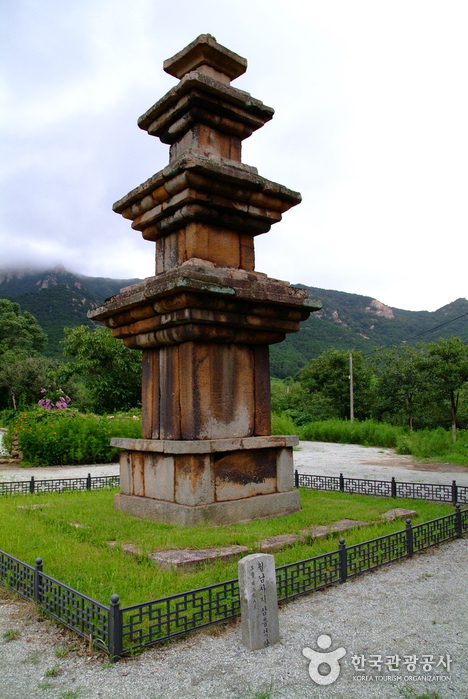
월남사지는 월출산 정상과 양자암을 배경으로 하고 있는 평지에 위치한 전면 175m, 측면 185m인 장방형의 사지로 총 면적은 1만여 평에 달하고 있으며 옛날에는 그 규모나 지세면에서 인근 무위사보다 컸으리라 추측된다. 지금은 백제계 석탑이라 하여 주목받고 있는 삼층석탑 (보물 298호)과 진각국사비 (보물 313호) 등 2점의 유물이 남아있으며 석탑을 주변으로 외각 담장의 흔적이 남아 있다. 또한 주변 민가에 사리의 기단석이나 탑의 기단부로 보이는 유물들이 남아 있다. 월남사지에서는 기와와 청자, 백자편 등 유물이 발견되었는데 이들 대부분이 고려에서 조선 시대의 유물들이며 특히 월남사의 건물 벽에 사용되었던 것으로 추측되는 청자타이루편이 발견되어 관심을 기울이게 하고 있다.
Gangjin Dawon 〉


Gangjin Dawon is a tea plantation operated by 'Taepyeongyang Dawon,' a leader in Korea's tea production industry, covering an area of 33.3 hectares. The plantation features gentle curves and vibrant greenery, creating a perfect harmony with the towering rocks of Wolchulsan. Wolchulsan is known for its mountain range surrounded by large rocks resembling folding screens, and tea trees have been cultivated here since ancient times around various temples. The renowned scholar Dasan Jeong Yak-yong once praised the tea from Wolchulsan as the second best in the world. Each early May, the foothills of Wolchulsan are painted a dazzling blue-green. In May, Gangjin Dawon has become a tourist attraction not only for tea ceremony enthusiasts but also for general visitors. Guests can enjoy more than sightseeing and photography—they can indulge in the subtle aroma of tea and try a unique experience of picking green tea leaves. While the lush green tea fields are beautiful, the winter scenery of Dawon also offers a new perspective for appreciating the tea fields.
Muwisa Temple 〉
★4.4(469)


According to the historical records of Muwisa, the first major reconstruction was carried out in 875 (Heon-gangwang 1) by Dosun Guksa, who founded it as Garoksa Temple. Shortly after, in 905 (Hyogongwang 9), Seongak Guksa Hyeongmi (864–917), a Seon master of the Gajisanmun lineage, stayed at Muwigapsa at the request of Goryeo's founder King Taejo Wang Geon, reconstructing the temple and widely spreading teachings gaining popular support. Thus, Muwisa was founded as Muwigapsa before the early 10th century when Hyeongmi resided there. However, the records state that in 946 (Jeongjong 1), Hyeongmi renamed the temple Moyoksa during a third reconstruction, but 946 was 30 years after Hyeongmi's death and the year the stele for the Goryeo State Muwigapsa Seongak Dae-sa Pyeon-gwang Yeong-tap was erected, making this unlikely. This is probably a later misunderstanding of Hyeongmi's major reconstruction with Wang Geon's support and his propagation of Buddhism. It is clear that Muwisa was founded before the early 10th century, reconstructed by Hyeongmi, and was a Seon temple of the Gajisanmun branch.
For this course, these stays make an easy overnight stop
Selected for easy access around the course and strong guest ratings


More recommended itineraries in this city
Travel Reviews
Share your travel tips & promote your social media.
Sign up to feature your channel.
(As a member, you can add your Instagram, YouTube, and blog links in My Page, and we’ll show them with every comment you write.)
- ✔ Your social media links appear with every comment you write.
- ✔ If your comment is chosen as a Best Comment, it’s also featured on our home page with your social media links.
““Stayed near Hongdae and did a night café tour. Perfect city views and vibes.””
Guest comments do not display social media links or profile cards.
Leave a traveler review
Share a short tip about this place.
Or leave a quick comment as a guest.
Drag & drop or click to add images (up to 6)
No reviews yet. Be the first to share your experience!