

Seohaerang Trail Gochang and Gunsan section
The Seohaerang-gil Gochang-Gunsan section is a course where you can encounter traces of time accumulated layer by layer from various angles and perspectives. The famous sandy beach, Myeongsasimni, which one might imagine to be found on an East Sea beach, stretches widely here. It is also a biosphere reserve where tidal flats, called the lungs of the Earth, spread like capillaries between the sea and land throughout the area. This section of Seohaerang-gil is ready to capture a completely new memory of the West Sea beyond common stereotypes. Walk the Gochang to Gunsan segment of Seohaerang-gil to experience it.
How was this place?
This course is a sample 4-day itinerary. Save it as-is or expand it into an AI itinerary.

Day 1
Gusipo Port 〉


Gusipo Port is a harbor that has been producing salt since around 1800. Its current name originated from the sluice gate installed for salt fields, which resembles a cow’s mouth canal (a dialect for trough). The surrounding scenery is beautiful, and it was selected as one of the '100 Beautiful Fishing Villages' by the Ministry of Oceans and Fisheries. Known for the dense pine forest and the spacious, firm sandy beach of Gusipo Beach, as well as the popular seawater steaming facilities. Located at the southern end of Gochang, Gusipo Port is uniquely situated on Gamakdo Island, separate from the mainland. Unlike other ports, it is not affected by tidal changes, allowing fishing boats to enter and exit freely. The port is widely developed in the shape of a wine glass, featuring an 800-meter long seawall extending into the sea, a lighthouse, an observation deck, trick art, and a park, providing a comfortable and enjoyable experience.
Gochang Dolmen Site [UNESCO World Heritage] 〉
![Gochang Dolmen Site [UNESCO World Heritage] 1](https://tong.visitkorea.or.kr/cms/resource/20/3018320_image2_1.jpg)
![Gochang Dolmen Site [UNESCO World Heritage] 2](https://tong.visitkorea.or.kr/cms/resource/21/3018321_image2_1.jpg)
![Gochang Dolmen Site [UNESCO World Heritage] 3](https://tong.visitkorea.or.kr/cms/resource/23/3018323_image2_1.jpg)
![Gochang Dolmen Site [UNESCO World Heritage] 4](https://tong.visitkorea.or.kr/cms/resource/24/3018324_image2_1.jpg)
Dolmens are a representative burial style of the Bronze Age, with more than 30,000 known to be distributed across Korea. They are densely concentrated in the southwestern coastal areas of the Korean Peninsula, including Jeonnam and Jeonbuk. As of 2003, 2,632 dolmens in 424 clusters were known in Jeonbuk. Notably, as of 2023, Gochang-gun alone holds about 1,748 dolmens, over 65% of Jeonbuk’s total. The Gochang Dolmen Site is clustered around Joklim-ri, Sanggap-ri, and Dosan-ri, and was designated a UNESCO World Cultural Heritage Site in December 2000. It forms the largest single cluster in Korea, featuring various types of dolmens such as table-type, checkerboard-type, and open-type in one area. The site also includes a quarry that provides insight into dolmen construction processes, serving as important material for understanding the evolution of dolmens in Northeast Asia. The World Heritage Committee recognized its value based on criterion (iii) for being unique or exceptionally old. Gochang offers exploration courses: Course 1 to Course 5 cover 1.8 km around Joklim-ri of Gochang-eup and Sanggap-ri of Asan-myeon, and Course 6 covers 1.7 km in Dosan-ri of Gochang-eup, preserving the appearance of diverse dolmens from 3,000 years ago.
Day 2
Gochang Ungok Ramsar Wetland 〉
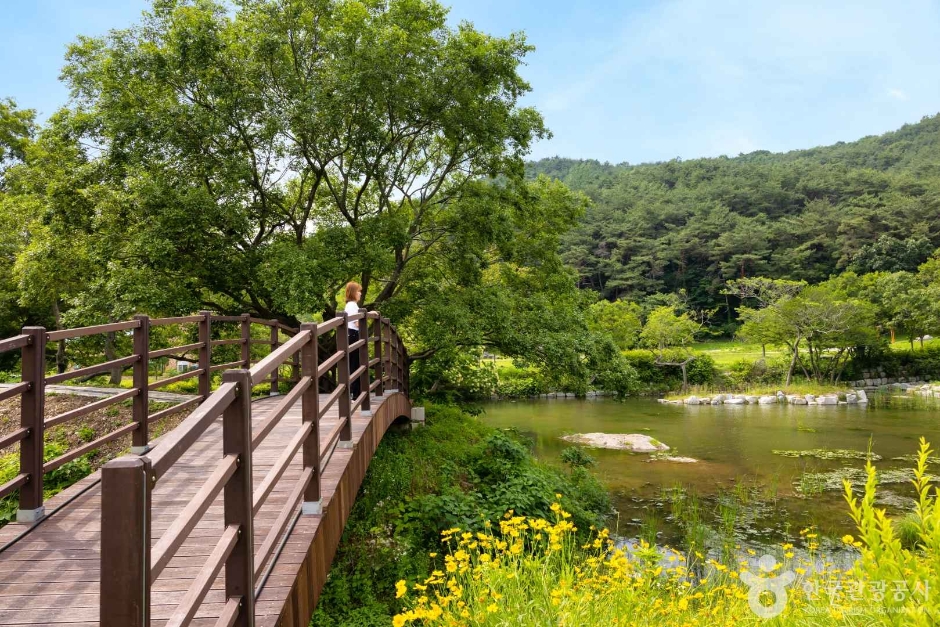


Ungok Wetland, designated as a Ramsar wetland in 2011, is a national ecotourism site and the best place to observe endangered wild animals and rare flora and fauna, where you can feel the strong vitality emitted by diverse life forms. Water around Ungok Ramsar Wetland gathers into the wetland through various streams, and the water system in the surrounding area flows mainly from Gochangcheon to Incheongang, then into Gomsoman Bay to the north. Large and small pools such as Andeokje and Ungokje are located here, serving as excellent habitats for wetland ecological resources by flowing into nearby ecological ponds. Around Ungok Reservoir, many plants in the families Asteraceae, Poaceae, Cyperaceae, Polygonaceae, Brassicaceae, Rosaceae, and Fabaceae are distributed. In Obeigol, there are willow and Populus davidiana communities; in Ungok village, aquatic plants are concentrated near the reservoir; in Andeokjegol near the reservoir, floating-leaved plants like lotus grow; various wetland plants inhabit the valley interior. As for animals, level 1 endangered wild species such as otters and white storks, level 2 endangered species such as leopard cats, Asian ratsnakes, fairy pittas, crested kingfishers, and Danbi bats live here, as well as Cultural Heritage Administration natural monuments like the red-bellied goshawk and common kestrel. Additionally, 533 fish individuals, 12 amphibian and reptile species, 611 bird individuals, 11 mammal species, 297 insect species, and 22 butterfly species inhabit the area.
Byeongbawi Rock 〉


Byeongbawi Rock is named for its shape resembling an upside-down bottle, and a legend says it became a rock when a fairy, intoxicated, kicked over a table and the bottle stuck into the ground. In fact, it has a unique form that can look like a human face depending on the viewing angle. Byeongbawi Rock is a landform formed by the weathering and erosion of rhyolite. It is harder and denser than the surrounding volcanic tuff, resulting in differential weathering. Due to this difference, the rhyolite forms vertical rock cliffs, presenting a scenic landscape and typical tafoni structures. Byeongbawi Rock holds high geological value.
Day 3
Chaeseokgang 〉


This sedimentary rock, formed about 70 million years ago from the Cretaceous period of the Mesozoic era under marine erosion, consists of the Gyeokpori Formation including conglomerate over conglomerate, alternating layers of conglomerate and sandstone, sandstone and mudstone, shale, and volcanic ash. This sedimentary environment suggests this area was once a deep lake where volcanic ejecta settled on the lakebed. Faults, folds, intrusion structures, and wave-cut platforms are also easily observed in these cliffs, making it excellent for studying topography and geology. Wave erosion has created sea cliffs, flat wave-cut platforms, and sea caves. The bottom of Chaeseokgang features potholes formed through crust and wave action, along with tidal pools formed by seawater trapped during high tide. ◎ Travel info to experience the charm of cold currents - The drama begins where Ban Ji-eum, carrying memories of a past life like waves, slowly walks at the towering cliffs and sea caves. The sedimentary rock formed since about 70 million years ago during the Cretaceous period seems to reflect the long years she has endured.
Suseongdang 〉


Suseongdang is a ritual shrine located in Gyeokpori, Byeonsan-myeon, Buan-gun. It is the only remaining communal village shrine in this coastal village, housed in a single-room tiled roof building measuring 4 pyeong. The shrine enshrines Gaeyanghalmi, the goddess overseeing the Chilsan Sea, along with her eight daughters. Every year on the 14th day of the first lunar month, a village shrine festival is held here. Gaeyanghalmi is a very tall goddess who wears wooden clogs and walks across the West Sea, filling deep waters and controlling storms to protect fishermen and passing ships. Excavations in 1992 uncovered artifacts dating from the late 3rd century to early 7th century from Baekje, Gaya, Unified Silla, Joseon, as well as ancient China and Japan. These artifacts confirm that people from China, Japan, and other countries also participated in the rituals here, and that various ritual items, including ceremonial vessels, were buried in the ground after the ceremonies. Nearby are Jeokbyeokgang and Chaeseokgang, and the shrine can be visited leisurely by walking the Seohaerang-gil and Buan Masil-gil trails.
Day 4
Seonyudo Beach 〉


Seonyudo Beach, located in Okdo-myeon, Gunsan-si, Jeonbukteukbyeoljachi-do, is a natural coastal sand dune beach with a wide, glass-like transparent and beautiful white sand, known as Myeongsasipri Beach. Even when you go about 100 meters into the water, the depth only reaches the waist, and there are no high waves, allowing safe water play. Moreover, the front sea is so clear it is almost cobalt blue, and the red sunset colors the evening sky, which is another gift from Myeongsasipri. Watching the sunset dye the sky and sea entirely red as it sinks into the sea, you are amazed anew by the wonder of nature.
월명공원 〉
월명공원은 월명산, 장계산, 설림산, 점방산, 석치산 등이 이어져 조성된 군산의 명소로 군산의 60~70년대에는 최고의 수학여행 코스였다. 총 면적이 약 77만 평이나 되고, 산책로의 길이도 12km나 되는 거대한 공원이다. 해망동과 신흥동에 걸쳐 있으며, 군산의 상징이자 월명공원의 상징인 수시탑에 오르면 군산 앞바다와 금강하굿둑, 그리고 군산시가지와 장항제련소 등의 주변 전경을 한눈에 살필 수 있다. 공원 정상에는 전망대와 바다조각공원, 수시탑, 삼일운동기념비, 개항35주년 기념탑, 생각하는 시민상, 채만식 문인비가 있다. 수시탑은 타오르는 불꽃과 바람에 나부끼는 돛의 형상을 띠고 있다. 공원 서쪽 설림산 기슭에는 고찰 은적사가 있으며, 점방산과 설림산 사이를 막아 만든 제일수원지가 있다. 공원 안은 조경이 잘되어 있으며, 수령 30년 이상의 등나무와 벚나무가 우거져 경관이 수려하다. 매년 4월에는 전국 규모의 벚꽃사진 촬영대회가 열린다. 사계절 모두 아름다운 공원이지만 특히 봄, 벚꽃이 만개했을 때의 모습이 가장 아름답다.
For this course, these stays make an easy overnight stop
Selected for easy access around the course and strong guest ratings


More recommended itineraries in this city
Travel Reviews
Share your travel tips & promote your social media.
Sign up to feature your channel.
(As a member, you can add your Instagram, YouTube, and blog links in My Page, and we’ll show them with every comment you write.)
- ✔ Your social media links appear with every comment you write.
- ✔ If your comment is chosen as a Best Comment, it’s also featured on our home page with your social media links.
““Stayed near Hongdae and did a night café tour. Perfect city views and vibes.””
Guest comments do not display social media links or profile cards.
Leave a traveler review
Share a short tip about this place.
Or leave a quick comment as a guest.
Drag & drop or click to add images (up to 6)
No reviews yet. Be the first to share your experience!