

Haeparang Trail
Haeparang-gil is the longest walking trail in South Korea, stretching a total of 750km and starting from Oryukdo in Busan. Among them, walk the Haeparang-gil in the northernmost Goseong and Sokcho sections of South Korea. The 48th and 49th courses of Haeparang-gil include the 'Kim Il-sung Villa' located in Hwajinpo and the 'Baekseom Marine Observatory' where you can see a beautiful sunrise. This course, which has villas where Kim Il-sung and Syngman Rhee rested, vividly shows the divided path of South Korea. The 47th course of Haeparang-gil passes by 'Seonang Rock,' which resembles a human profile, and leads to 'Wanggok Village,' a yangtongjip and uniquely structured traditional house found only in northern Gangwon. On the 46th course, sit and ponder at 'Neungpadae,' where waves crash against the rocks, and also walk to Janghang Port. The 45th course is a Sokcho-only route. This course includes 'Yeongnangho,' where Yeongnang, a Silla Hwarang, stayed and is captivated by the posture of Beom Rock crouching; 'Yeonggeumjeong,' where you can meet the sea by crossing a cloud bridge about 50m long; and 'Cheongchoho,' notable for its sparkling night view.
How was this place?
This course is a sample 4-day itinerary. Save it as-is or expand it into an AI itinerary.

Day 1
Kim Il-sung Villa 〉
★3.7(3.9k)


This villa is located overlooking Hwajinpo in Hwapo-ri, Geojin-eup, Goseong-gun, Gangwon Special Self-Governing Province, and is commonly called the 'Kim Il-sung Villa.' It was built in 1938 by German H. Weber and was used as a summer retreat from 1948 to 1950 by Kim Il-sung along with his wife Kim Jong-suk, son Kim Jong-il, and daughter Kim Kyong-hui. It is a stone building with one basement floor and two above-ground floors. The army demolished and rebuilt the building in 1964 and repaired it in 1995 for use as a soldiers' rest facility. Inside, exhibits related to the Korean War and North Korea are displayed. Along with the Lee Seung-man Villa and Lee Ki-bung Villa about 1 km away, it forms a historical security exhibition center.
백섬해상전망대 〉
거진항 어촌관광체험마을 조성사업의 일환으로 2019년 3월부터 2020년 10월에 걸쳐 조성하였으며, 2020년 10월 30일 관광객에게 개방되었다. 총길이 137m, 높이 4~25m 규모로 해안도로와 백섬(백암도)을 연결하여, 아름다운 동해바다 위를 걸으며 북쪽으로는 해금강과 금구도를 조망할 수 있으며, 남쪽으로는 거진항구와 거진11리 해변이 펼쳐져 장관을 이룬다. 높이 25m의 전망대 일부에는 투명한 강화유리 바닥이 조성되어있다. 거진 뒷장에 위치한 백섬(백암도)과 해안도로를 연결하는 해상데크로 길이 137m, 폭 2.5m, 높이 4~25m 규모이다. 해상전망대에 오르면 동해바다와 해금강, 금구도, 거진항구의 아름다운 경치를 관람할 수 있다.
Goseong Wangkok Village 〉
★4.1(1.3k)


Wangkok Village is located about 1.5 km inland from the coast and is surrounded by five hills shaped like peaks about 200m above sea level and the lagoon Songjiho (circumference 4km, area 200,000 pyeong), forming a basin in the shape of a 'gol' isolated from the outside. To the east of the village is Golmusang, to the southeast Songjiho, to the south Hogunsan and Jegoksan, to the west Jinbangsan, and to the north Oeumsan. Oeumsan, located north of the village, extends southwest through the village along the Wanggokcheon stream, forming a settlement with deep longitudinal shape. Houses are naturally arranged along the village road that follows the stream in the village center, characterized by relatively wide vegetable gardens between houses without separate fences, separating the houses by the garden boundaries. The house structure of Wangkok Village includes an anbang (main room), dojangg (storage room), sarangbang (men’s quarters), maru (wooden floor room), and kitchen all in one building, with the kitchen attached to a livestock pen in a combined house structure. The front yard, directly connected to the village road, serves as a communal work space open to outsiders, while the backyard, surrounded by relatively high walls, is a private space for women and not open to others. Only the roof of the backyard is visible, reflecting a design considerate of women's activity space. The traditional houses of Wangkok Village, full of history and tradition, also offer lodging experiences. One can escape modern urban life and spend quiet, relaxed time in a place where time seems to have stopped, living just as 200 years ago.
Day 2
Songjiho Coastal Seonnang Rock 〉
★4.4(316)


Seonnang Rock is a rocky coast developed in the granite area south of Songjiho Beach, where weathering landforms of granite and wave erosion combine to create a very unique geological landscape. In particular, thick quartz veins intrude between granite layers, forming a distinctive appearance. The name Seonnang Rock comes from the Seonnangdang (Seonghwangdang) shrine of Oho-ri village located there. Seonnangdang is a traditional Korean shrine area dedicated to the village guardian deity, Seonnangshin (Seonghwangsin), and is a place where it is taboo to damage or remove objects freely. Additionally, Seonnang Rock changes shape depending on the viewing direction (east, west, south, north), and is nicknamed Snoopy Rock because it resembles Snoopy. Especially remarkable is a small pine tree growing atop the rock. Next to the fan-shaped rock, there is another curious rock: a cube-shaped rock with a hole in the center and a small pine tree growing between its cracks.
Neungpadae 〉
★4.2(911)


Neungpadae (凌波臺) is a large-scale tafoni colony developed on the rocky coast forming a land-tied island called Yukgyedo (陸繫島). The name Neungpadae, meaning “the rock island surpassing the waves,” was given because of the sight of waves crashing against the rocks. Yukgyedo refers to an island connected to the mainland by accumulated sand dunes, and tafoni are groups of holes clustered like a honeycomb on the rock surface (cliffs). Originally, Neungpadae existed as a granite bedrock island (rock reef) exposed in front of Munam Coast but connected to land by sand deposited behind the island by Munam Stream as wave action decreased. However, now Munam 2-ri harbor has been built along the southern boundary of Neungpadae, and settlements have arisen on the land-tied sandbar connecting the island and Munam Coast, so the original form of Yukgyedo is hardly observable. (Source: Gangwon Peace Region National Geopark website)
Day 3
장사항 〉
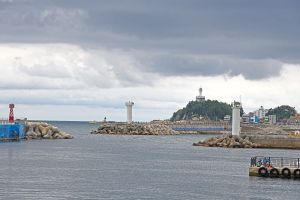
장사항은 속초시 장사동 일원에 위치한 소규모 어항으로서 방파제 90m, 방사제 144m, 물양장 130m 및 어선 30여척을 보유한 전형적인 어촌으로, 주위에 횟집 및 활어판매장이 50여곳이 있어 싱싱한 활어회를 즐기기에 안성맞춤이며 특히 가까운 곳에 배낚시 어장이 형성되어 바다낚시를 즐길 수 있는 최적지이다. 이곳에서는 매년 여름 피서철 동안 오징어를 맨손으로 잡는 축제가 열려 시원한 즐거움을 더해준다.
Yeongrangho Lake 〉
★4.6(90)


Yeongrangho Lake is a natural lagoon formed by the development of coastal sand dunes, with a circumference of 7.8 km and an area of about 1.2 square kilometers. It is wide and deep, with a depth exceeding 8 meters. Water flowing from Jangcheoncheon connects to the East Sea through a waterway under Yeongranggyo Bridge. Surrounded by Jangsadong, Yeongrangdong, Dongmyeongdong, and Geumhodong in Sokcho-si, a walking trail perfect for strolls is built along the lakeshore. Along the trail, a lyrical and beautiful landscape flows with clear, calm water, cherry blossoms, azaleas, and reeds. According to the Samguk Yusa, Yeongrangho is said to be named after ‘Yeongrang,’ a Hwarang of the Silla dynasty. After finishing training at Geumgangsan, Yeongrang passed this lake on his way to a martial arts competition but became so captivated by the scenery that he forgot the competition and stayed here a long time. The lake is renowned for its outstanding scenery, as recorded in old documents. Especially Beombawi, one of Sokcho’s eight scenic spots, amazes all who see it, with a mysterious aura as if a tiger is quietly crouching. Gwaneumam and Bogwangsa, with several weirdly shaped rocks, are also unmissable attractions. The wetland ecological park located west of the lakeshore is also worth visiting.
Day 4
Yeonggeumjeong 〉
★4.3(11.8k)
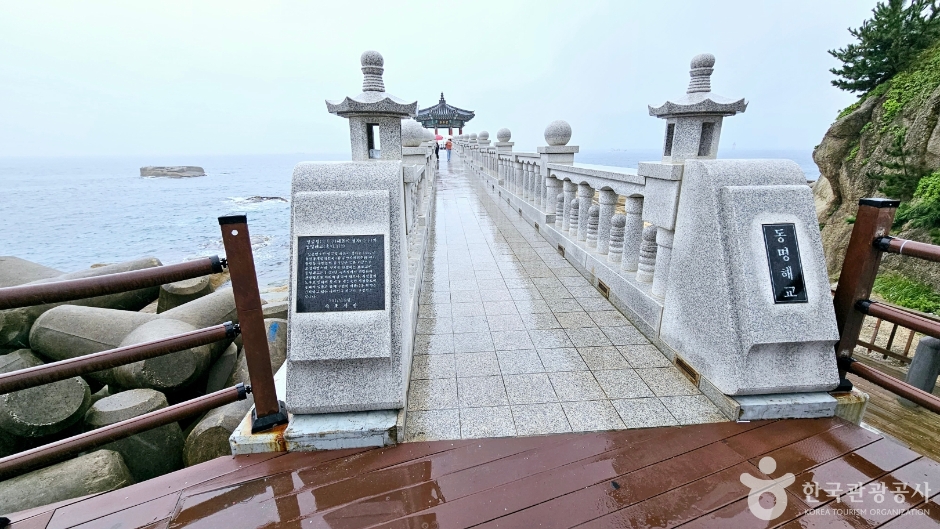


Yeonggeumjeong is a place with large and wide rocks spread along the seaside under Sokcho Lighthouse in Dongmyeong-dong, Sokcho-si. The origin of the name comes from the mysterious melody heard when waves hit the rocks, said to resemble the sacred sound of a 'geomungo' (traditional Korean zither), hence it is called Yeonggeumjeong. Located close to the city center, it offers beautiful scenery and is a popular spot year-round for Sokcho citizens to enjoy summer retreats and fishing. Currently, Sokcho-si has developed the Yeonggeumjeong area into a tourist site, and a pavilion was built near the southern breakwater. This pavilion is a maritime pavilion built on the Yeonggeumjeong rocks and can be reached by crossing a bridge of about 50 meters. The feeling of looking out at the sea from the pavilion is refreshingly different from the breakwater, but the pavilion itself is made of concrete, which is somewhat disappointing. It is generally called the Sunrise Pavilion, and the pavilion's nameplate bears the inscription Yeonggeumjeong (靈琴亭).
Cheongcho Lake 〉

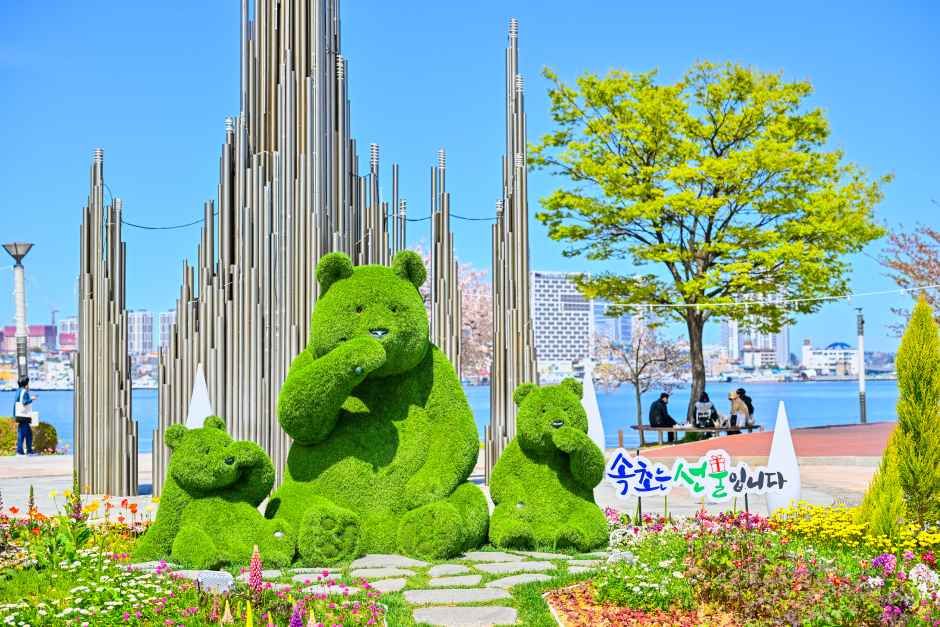
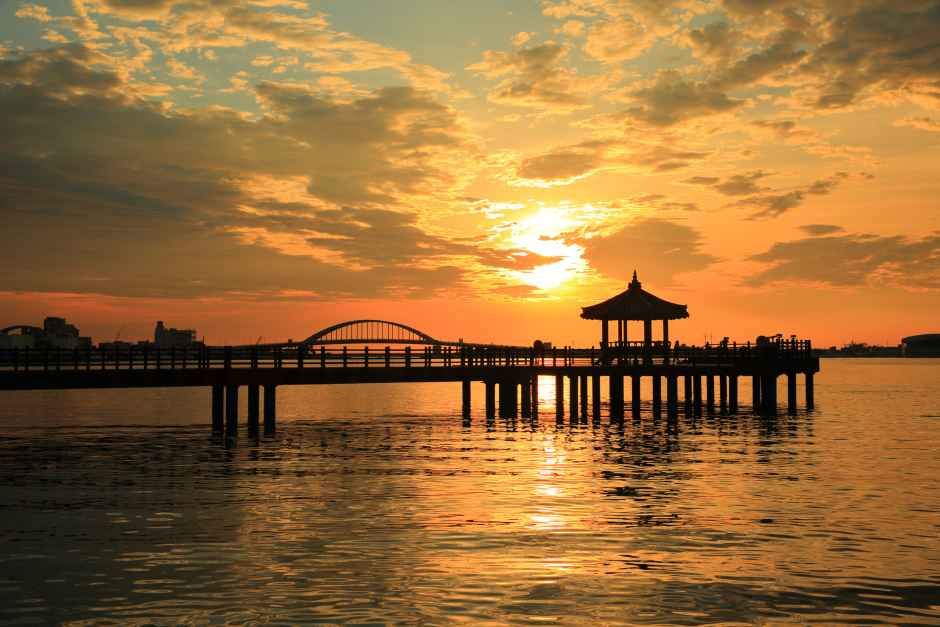

Cheongcho Lake, located in the center of Sokcho-si, is a large natural lagoon with a circumference of 5 km and an area of 1.3 km². Cheongcho Stream, originating near Misiryeong of the Taebaek Mountains, flows to the East Coast, forming this beautiful lake before draining into the adjacent sea. It resembles an intermediate stop connecting a river and the sea. On the lake stands Cheongchojeong Pavilion, offering views of Seoraksan Mountain and the East Sea. Located at the end of a 75 m sea footbridge, it feels as if it is in the middle of the lake. Cheongchojeong shines even more brightly at night and is regarded as one of the best night view spots in Sokcho. The Cheongryong (Blue Dragon) and Hwangryong (Yellow Dragon) sculptures, reflecting the lake's dragon legend, also attract attention. A walking trail around the lakeshore is equipped with night lighting and is popular after dark. Benches placed throughout provide restful spots overlooking the lake. Nearby notable places include Seokbong Ceramic Art Museum and migratory bird habitat. Cheongcho Lake Park, created along the shore, was the venue for the 1999 Gangwon International Tourism Expo and features the 73.4 m tall Expo Tower observatory.
For this course, these stays make an easy overnight stop
Selected for easy access around the course and strong guest ratings


More recommended itineraries in this city
Travel Reviews
Share your travel tips & promote your social media.
Sign up to feature your channel.
(As a member, you can add your Instagram, YouTube, and blog links in My Page, and we’ll show them with every comment you write.)
- ✔ Your social media links appear with every comment you write.
- ✔ If your comment is chosen as a Best Comment, it’s also featured on our home page with your social media links.
““Stayed near Hongdae and did a night café tour. Perfect city views and vibes.””
Guest comments do not display social media links or profile cards.
Leave a traveler review
Share a short tip about this place.
Or leave a quick comment as a guest.
Drag & drop or click to add images (up to 6)
No reviews yet. Be the first to share your experience!