

In Search of King Munmu Reborn as a Dragon of the Sea
Crossing Tohamsan Mountain from Gyeongju city, you will find temples such as Girimsa and Golgulsa along the way to trace the footsteps of King Munmu, the leading figure of the unification of the Three Kingdoms. Famous for the Seonmudo martial art, Golgulsa features a rock-carved Buddha statue, followed by a visit to the calm and tranquil Girimsa temple. Explore the underwater tomb of King Munmu and the site of Gameunsa Temple built by King Sinmun, then enjoy the sea of Gyeongju.
How was this place?
This course is a sample one-day itinerary. Save it as-is or expand it into an AI itinerary.
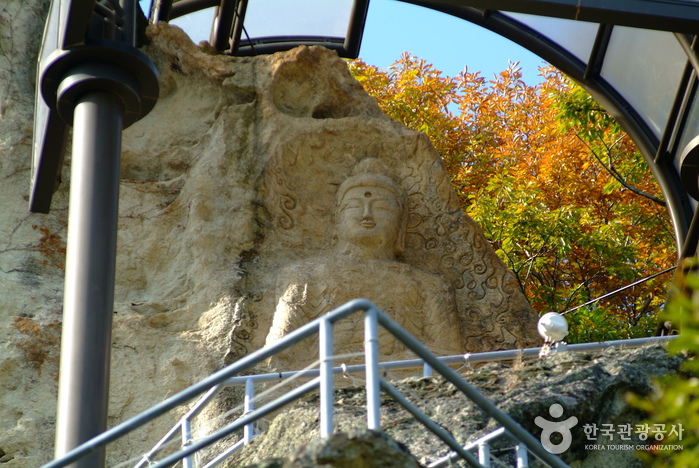
Golgulam Ma-aeyeorae Seated Buddha Statue 〉


This is the Ma-aeyeorae seated Buddha statue located at the highest part of 12 stone caves made using a natural cave on the high cliff of Golgulam. In the Joseon Dynasty, the painting 'Golgulseokgul' by Gyeomjae Jeong Seon depicted a wooden front chamber, but now only traces remain on the rock. On the shaved head, the topknot-shaped hair (yukke) rises high, and the clearly defined face shows a more advanced formalization than before in the thin eyes, small mouth, and narrow long nose. Compared to the three-dimensional face, the flat body is widely expressed with shoulders almost horizontal, although the neck and upper chest are damaged. The folds of the clothing mainly feature regular parallel lines, and a V-shaped pattern indicates the curves of the arms and body between the armpits. The flat carving of the halo on the cliff can be seen through the lotus pattern of the head halo and the rhythmic flame patterns around the Buddha statue. The flat body, the thinly crafted stepped clothing folds, and the U-shaped clothing folds between the armpits resemble the stone Seated Vairocana Buddha statue from Bonghwa Chukseosa Temple and wooden halo created in 867, suggesting it was made in the late Unified Silla period.
Girimsa Temple 〉


Girimsa Temple was founded during the reign of Queen Seondeok of Silla and was originally called Imjeongsa before Wonhyo expanded the temple grounds and renamed it Girimsa. The temple is divided into two main areas: one with Daejeokgwangjeon Hall enshrining Vairocana Buddha and a large bodhi tree over 500 years old, and another area housing the Treasure Museum, Samseong-gak, Myeongbujeon, and Gwaneum-jeon. Daejeokgwangjeon, the temple's main hall, features a column-fluted dapo-style single-story gabled roof structure and enshrines a triad of statues typical of early Joseon Buddha images. To the west between Daejeokgwangjeon and Jinnamru is the 500 Arhat Hall, in front of which stands a three-story stone pagoda. The Treasure Museum contains many cultural heritage items, including the designated treasure Ganchil Bodhisattva half-body statue, relics stored within the Vairocana Buddha statue, wooden statues, and stone earth-made jimi figures. Girimsa is also famous for five-flavored water called Ojong-su. These include Gamrosu, best for brewing tea; Hwajeong-su, known for calming the mind even when drunk plain; Janggun-su, said to strengthen the body; Myeongan-su, clearing the eyes; and Otak-su, so clear that crows pecked at it. However, during the Japanese colonial period, the water flow of Janggun-su was blocked due to fears of producing generals, and now water springs at only four of the five sources. The temple offers mountain temple experience programs and templestay, including a self-guided relaxation type and an experience type with monks featuring participation in ceremonies and 108 prostrations. Seasonal themes include green tea making in spring, meditation trail experience at Yongyeon Waterfall in summer, tastings of lotus leaf tea and temple music concerts in autumn, and bell-ringing ceremonies and East Sea sunrise viewing in winter. Additionally, there are mandala drawing activities, Mahasa summer retreats, and children's summer Buddhist schools available.
Gyeongju Gameunsaji Temple 〉

Gameunsa Temple is a Unified Silla period temple located on the east coast, established by King Munmu of Silla after unifying the Three Kingdoms to invoke the power of Buddha to repel Wako invasions. Before the temple was completed, King Munmu died, and his son, King Sinmun, completed it in 682, continuing his father's will. Before his death, King Munmu wished to become a sea dragon to protect the country and requested his cremation and burial in the East Sea. His tomb is at Daewangam, and King Sinmun named the temple Gameunsa to express gratitude for his father's grace. Currently, only two three-story stone pagodas, the main hall site, and lecture hall site remain. Along with Hwangnyongsa and Sacheonwangsa, it was a national protective temple, but the timing of its ruin is unknown. The current state of Gameunsaji was exposed and restored based on the foundational structures through a full excavation from 1979 to 1981. Additionally, a symbolic passage allowing East Sea water to enter under the main hall was created, representing King Munmu’s transformation into a sea dragon to rest. The two soaring three-story stone pagodas, symbolizing Gameunsaji, are early Unified Silla pagodas assembled from dozens of parts and are the largest stone pagodas in Korea.
Gyeongju Munmu Daewang Tomb 〉


This is the underwater tomb of Munmu the Great, the 30th king of Silla (reigned 661–681), offering insight into the creative thoughts of the Silla people. It is located 200m offshore from Bonggil-ri in the East Sea and is exposed above sea level about 35m east-west, 36m north-south, and 5.3m high. Munmu continued the achievements of his father, King Taejong Muyeol, defeated Goguryeo, repelled Tang invasions, and achieved the unification of the Three Kingdoms. He also established central government offices such as the Ministry of War and the Ministry of Stores, laid the foundation for local governance with the five small administrative units and the military system of nine seodang and ten jeong. Having unified the Three Kingdoms, Munmu wished to become a dragon to protect the kingdom against invading Japanese pirates, ordering his body to be cremated in Buddhist rites and his ashes to be buried in the East Sea. This rock is called Daewangam or Daewang Rock, and an underwater royal tomb like this is unparalleled worldwide. Daewangam was made using natural rock; artificial waterways in a cross shape were created east-west and north-south on the rock island, with a small pond-like harbor in the center. A flat turtle-shaped stone measuring 3.7m long, 2.06m wide, and 0.9m thick is placed two meters underwater, believed to house his ashes underneath. His son, King Sinmun, built Gameunsa Temple near the East Sea, designing a drainage channel beneath the Dharma Hall facing the sea to allow the dragon-turned Munmu to travel.
Gyeongju Igyeondae 〉


There are two significant places to observe Daewangam meaningfully. One is Igyeondae in front of Daebon Elementary School, and the other is the site under the Donghaegu (East Sea Entrance) marker stone where the monument 'My Unforgettable Sea' stands. Igyeondae is the historic site where King Munmu, who refused lavish tombs and vowed to protect the country as a dragon of the East Sea, showed his transformed dragon form. His son, King Sinmun, obtained the priceless treasure Manpasikjeok here. The name Igyeondae is taken from the I Ching phrase 'The flying dragon is in the sky; it is beneficial to see the great man (飛龍在天 利見大人).' The current building was newly constructed based on the foundation stones revealed during the 1970 excavation. Descending below the Donghaegu marker, visitors see the monument 'My Unforgettable Sea,' erected in 1985 by the disciples of scholar Go Yu-seop to honor his anti-Japanese resolve. This monument and Go's poem 'Daewangam' stand side by side at a spot overlooking Daewangam, underscoring the significance of King Munmu's national defense will against Japanese invasion attempts justified under the pretext of Japan-Korea Unity during the Japanese colonial period, reflecting resistance dating back to the Unified Silla dynasty.
Songdaemal Lighthouse 〉


Songdaemal Lighthouse, located north of Gampo Port in Gyeongju-si, Gyeongsangbuk-do, was originally built as an unmanned lighthouse to ensure maritime safety in the waters in front of Gampo, where reefs stretch long from the end of the land causing frequent accidents of small ships. It was later upgraded to a manned lighthouse and operated as such but is now no longer in use. Instead, a new five-story lighthouse building modeled after the Gamuensa Temple Stone Pagoda, a symbol of Gampo-eup, was built next to it. The first and second floors serve as a light experience exhibition hall providing a unique attraction for tourists, while the third, fourth, and fifth floors now fulfill the original lighthouse’s role by illuminating the sea in front of Gampo. The first floor of the exhibition hall contains detailed records about the history of Gampo Port and Songdaemal Lighthouse. Songdaemal means the tip of pine trees, and the lighthouse is warmly surrounded by a dense forest of 300 to 400-year-old pine trees. A wooden deck path for visitors is installed in front of the lighthouse, making it a pleasant spot for a stroll and to enjoy the surrounding scenery. Above all, it is a renowned sunrise spot on the eastern coast of Gyeongju, along with the Munmu Daewang Tomb and Yangnam Columnar Joint.
For this course, these stays make an easy overnight stop
Selected for easy access around the course and strong guest ratings


More recommended itineraries in this city
Travel Reviews
Share your travel tips & promote your social media.
Sign up to feature your channel.
(As a member, you can add your Instagram, YouTube, and blog links in My Page, and we’ll show them with every comment you write.)
- ✔ Your social media links appear with every comment you write.
- ✔ If your comment is chosen as a Best Comment, it’s also featured on our home page with your social media links.
““Stayed near Hongdae and did a night café tour. Perfect city views and vibes.””
Guest comments do not display social media links or profile cards.
Leave a traveler review
Share a short tip about this place.
Or leave a quick comment as a guest.
Drag & drop or click to add images (up to 6)
No reviews yet. Be the first to share your experience!