

Taste of Sunchang gochujang red chili paste
Clear and pristine Sunchang has captivated South Korea with the taste of its gochujang. To experience Sunchang's gochujang, visit the Sunchang Traditional Gochujang Folk Village. There is a Jangryu Museum and a Jangryu Experience Center where you can learn in detail about gochujang and try making it yourself. Explore Gangcheonsa Temple and also see the two remaining stone jangseung and the Hyanggyo Confucian school in Sunchang-eup. End your trip at the Seomjin River, which flows through the mountains and fields of Sunchang.
How was this place?
This course is a sample one-day itinerary. Save it as-is or expand it into an AI itinerary.

Gangcheonsa Temple 〉


Gangcheonsa Temple, located 1.8 km from the entrance of the Gunrip Park, was founded by Doseon Guksa in 887, the first year of Queen Jinseong of Silla. It prospered afterward; in 1316, the third year of King Chungsuk of Goryeo, Deokhyeon Seonsa restored the temple and built a five-story stone pagoda. At one time, it had 12 hermitages and housed about 1,000 monks. However, during the Imjin War, all were destroyed except the stone pagoda. In 1604, during the 37th year of King Seonjo, Soyodaesa rebuilt it, but it was again destroyed in the Korean War and restored to its original state in 1959. Cultural assets include Chungsin-ri and Namgye-ri, stone jangseung totems, Sunchang Guesthouse, and the three-story stone pagoda in Sunhwal-ri. Nearby tourist attractions include Geumseongsanseong Fortress, Yongso Waterfall, Gangcheonho, Damyangho, Chuwolsan, Huimunsan, and Naejangsan National Park.
Sunchang Jangryu Experience Center 〉


Located in front of the traditional Gochujang folk village, Sunchang Jangryu Experience Center was established to widely research, distribute, and promote the globalization of the jangryu industry while preserving the traditional taste and style of Sunchang jangryu. Visitors can make and take home the nationally representative traditional Sunchang Gochujang, as well as cook and taste delicious dishes made with traditional Sunchang Gochujang, offering an open hands-on experience space. The center provides various facilities necessary for traditional jangryu experiences, such as a cooking experience hall and outdoor learning area, and it is designed to offer both domestic and foreign visitors the opportunity to experience and tour jangryu culture.
Okcheongol Hanjeongsik 〉


Okcheongol Hanjeongsik is a restaurant located near the Gyeongcheon Bridge, past the Sunchang IC intersection. It offers grilled beef bulgogi and pork bulgogi cooked on a griddle, more than 20 side dishes, and doenjang jjigae, preserving the authentic traditional flavors. The vegetables and even the rice served are homegrown, allowing guests to truly experience the proper Jeollado-style table setting.
충신리석장승 〉
전라북도 순창군 순창읍에 있는 석장승은 순창읍에서 북쪽으로 약 500m지점 임실을 거쳐 전주로 가는 대로변 오른편 (동쪽) 논둑에 서 있다. 순창은 풍수상으로 북풍을 막기 위해서 옛날에는 이곳에 비보림이 있었고 숲 속에 당이 있었으나 지금은 당우는 없고 당 앞 좌석에 석장승이 있었다고 한다.
순창남계리석장승 〉
순창읍 남계리에 홀로 서있는 돌장승이다. 원래는 한 쌍으로 세워졌던 듯 하나 지금은 하나만 남아 있다. 순창읍에서 남원으로 가는 길의 개울둑을 타고 200m쯤 가면 돌장승이 서 있으며 마을의 평화와 주민들의 건강을 비는 뜻으로 세운 것이다. 이 장승은 조선시대의 것으로 만들어진 정확한 연대는 알 수 없으나 형식에 얽매이지 않고 토속적이고 민중적인 예술작품이라는 점에서 연구가치가 있는 민속자료이다.
Sunchang Hyanggyo 〉


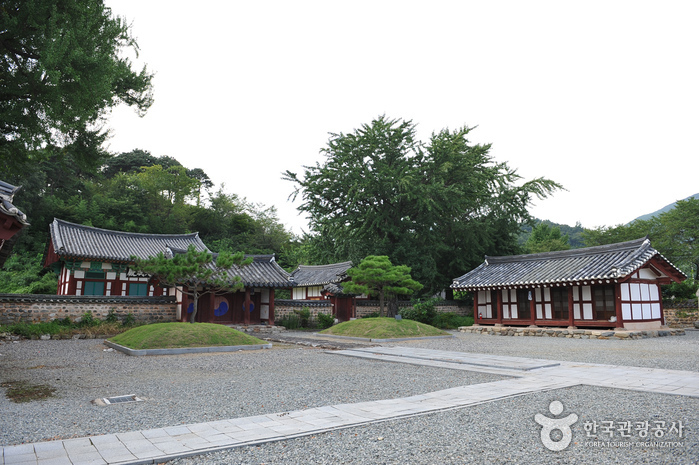
Sunchang Hyanggyo, designated as Cultural Heritage No. 68 of Jeonbuk Special Self-Governing Province, preserves the architectural style of hyanggyo from the early Joseon period. Although the exact date of establishment is unknown, it is estimated to have been built during the reign of Seongjong (1469–1494). It originated in Gokcheon-dong during the reign of Goryeo's King Gongyang by Governor Choi Jabi and was relocated to its current location in Okcheon-dong in 1489 by County Magistrate Kim Sugwang under the direction of Mongam Lee Sookgam. Existing structures include Daeseongjeon, Dongmu, Seomu, Myeongnyundang, Dongjae, Seojae, Naesammun, and Oesammun. Daeseongjeon measures three kan in front and three kan in side, while Myeongnyundang is seven kan by two kan. Daeseongjeon enshrines the Five Stars and Ten Philosophers of China, six ancient sages of the Song Dynasty, and 18 sages of Korea. On the 1st and 15th of each lunar month, Sagnam bunhyang rites are held, and in spring and autumn, the Seokjeon festival is conducted.
Seomjingang 〉


The Seomjingang River originates from the western valley of Palgongsan in Sinam-ri, Baegun-myeon, Jinan-gun, Jeollabuk-do and flows northwest, forming the Galdam Reservoir at the boundary between Jeongeup-si and Imsil-gun. It flows southeast through Sunchang, Gokseong-gun, and Gurye-gun, and empties into Gwangyang Bay at the boundary between Geumseong-myeon, Hadong-gun and Jinwol-myeon, Gwangyang-si. Geographically, it spans the three provinces of Jeollanam-do, Jeollabuk-do, and Gyeongsangnam-do. Historically, it was a collision zone of ancient Gaya and Baekje cultures, a boundary between Silla and Baekje, a route for Japanese invasions during the Imjin and Jeongyu Wars, and in the late Joseon period, a site where the Donghak Peasant Revolution culminated. Major tributaries include Churyeongcheon (joining from Sanae-myeon, Jeongeup-si), Iljungcheon, Osucheon, Simchocheon, Gyeongcheon, Okgwacheon, Yocheon, Sujicheon, Boseonggang, Hwangjeoncheon, Seosicheon, Garinae, Hwagaecheon, and Hoengcheongang. Originally, the Seomjingang was called Dochigang, Moraegaram, Moraenae, Dasagang, Daesagang, Sacheon, and Gimunha, named for its fine sand. According to legend, in 1385 (11th year of King U of Goryeo), a swarm of toads cried out at the river mouth when Japanese pirates invaded, causing them to flee toward Gwangyang, which led to the name 'Seomjingang' (with the toad character 蟾). Downstream in Unsu-ri, Hwagae-myeon, Hadong-gun, there is Ssanggyesa Temple, rebuilt in 840 during Silla, as well as Bulilam and Bulil Waterfall. Notable local products include sweetfish and freshwater crabs.
For this course, these stays make an easy overnight stop
Selected for easy access around the course and strong guest ratings


Travel Reviews
Share your travel tips & promote your social media.
Sign up to feature your channel.
(As a member, you can add your Instagram, YouTube, and blog links in My Page, and we’ll show them with every comment you write.)
- ✔ Your social media links appear with every comment you write.
- ✔ If your comment is chosen as a Best Comment, it’s also featured on our home page with your social media links.
““Stayed near Hongdae and did a night café tour. Perfect city views and vibes.””
Guest comments do not display social media links or profile cards.
Leave a traveler review
Share a short tip about this place.
Or leave a quick comment as a guest.
Drag & drop or click to add images (up to 6)
No reviews yet. Be the first to share your experience!