

Namparang Trail Yeosu section
The 'Nampalangi' is a 1,470 km trail stretching from Oryukdo in Busan Metropolitan City to Ttangkkeut in Haenam-gun, Jeollanam-do. It is a youthful path walked with the romance of the night sea. Known as the Napoli of Korea, Yeosu, surrounded by sea on three sides, is an archipelago with about 400 scattered islands. The Yeosu section of Nampalangi, running along this beautiful coastal city, connects Yeongchwisan, Yeosu Marine Park, Soho Dongdong Bridge, and Nangdo, where visitors can feel the romance of Yeosu.
How was this place?
This course is a sample 4-day itinerary. Save it as-is or expand it into an AI itinerary.

Day 1
Yeongchwisan 〉


Yeongchwisan, located across Samildong and Sangamdong in Yeosu-si, is a mountain with a modest elevation of 510m. Although it is neither tall nor notably scenic, Yeongchwisan is famous nationwide for being the first place in Korea to see azaleas bloom in spring, turning the entire mountain red. Along with Hwaoksan in Changnyeong, Gyeongnam, and Muhaksan in Masan, Gyeongnam, it is considered one of the three largest azalea habitats in the country. Tens of thousands of azalea plants aged 30–40 years grow naturally in a cluster spanning approximately 330,000 square meters, setting the mountain ablaze with red every April. The hike up Yeongchwisan is family-friendly, taking about four hours via any trail given the mountain's low height. The best route to enjoy azaleas starts at the forest road above Honamjeongyu or Sangam Elementary School, passes the 450m peak, ascends to Yeongchwisan's summit, descends to Bongwoojae, climbs back up to Jinraebong, then proceeds through the heliport and the 439m peak, finally turning right at the fork to descend to Heungguksa Temple. Overnight hikes typically start from Heungguksa Temple and follow the reverse course. The trail from the 450m peak to the summit has the richest azalea blooms but can be rugged and potentially dangerous in low light, so hikers should carefully plan their time. Yeongchwisan holds an azalea festival every April, featuring diverse events such as the Yeongchwisan Mountain God Ritual, youth essay contests, photography competitions, azalea maiden contests, and local food offerings, providing visitors with various attractions and refreshments. The name Yeongchwisan is believed to be derived from the Yeongchwisan mountain in India where Buddha gave his final sermon.
Heungguksa Temple 〉


Heungguksa Temple, located within Yeongchwi Mountain, was established to pray for the prosperity of the country, as its name suggests. It was founded with the wish that if the nation prospers, the temple will prosper, and if the temple prospers, so will the nation. Near the Yeosu National Industrial Complex, Heungguksa was founded by Bojo Guksa in 1195. Within the temple grounds are cultural assets including the Daeungjeon Hall, Wontongjeon Hall, and Palsangjeon Hall. The Daeungjeon Hall is notable for its latticed doors that can be fully opened. The rear mural painting of Daeungjeon is designated as a treasure, and the elegant Hong-gyo Bridge at the entrance of Heungguksa showcases its treasure value. Additionally, there are seven more treasures such as the Daeungjeon rear mural (Yeongsan Hoe Sangdo), Nosanabul suspension painting, Suwol Gwaneum painting, sixteen Arhats paintings, wooden Shakyamuni triad, Yeosu Heungguksa Temple bell, wooden Ksitigarbha triad, and a set of King of Hell statues along with associated relics. During the Imjin War, over 300 naval Buddhist warrior monks were stationed within the temple grounds, where they trained. From early April for about a month, the ridge extending behind Daeungjeon from Yeongchwibong to Jindallaebong is spectacular with clusters of azaleas bursting into bloom.
Mipyeong Bonghwasan Forest Bathing Site 〉
★4.6(7)


Mipyeong Bonghwasan Forest Bathing Site features an accessible walking trail, barefoot trail, and a children's forest, designed for the comfort and safety of all citizens including the elderly, disabled, pregnant women, and children. Visitors can enjoy forest bathing while walking and resting with mutual consideration for each other. The site includes a foot-washing area for barefoot walking, rest areas, restrooms, parking lots, as well as wooden bridges and a diversion dam.
Day 2
Hallyeohaesang National Park 〉


Odongdo is an island in Yeosu-si that looks like an orchid tree leaf from afar and has been called Odongdo because of the abundant paulownia trees since the past. It is both the starting and ending point of Hallyeohaesang National Park. The island, with an area of 125,620.4m² (38,000 pyeong), is covered with a dense forest of 193 rare trees including camellia trees, Isaut bamboo, true camellia, hoopaek tree, zelkova, and privet. Especially, the camellia trees naturally growing here form a large colony, earning the island the nicknames Camellia Island or Flower Island of the Sea. Around 3,000 camellia trees cover the entire island, with flowers starting to bloom one or two at a time as early as October, allowing the sight of red flowers even in midwinter. About 30% bloom by mid-February, reaching full bloom by mid-March. The coast is rocky with high sea cliffs developed, creating spectacular rocky cliffs known as Conch Rock, Folding Screen Rock, Elephant Rock, Dragon Cave, and Roof Rock. Odongdo Lighthouse is located at the southern tip of the island. Vehicle access is restricted except for authorized vehicles. Transportation into the island from the entrance includes the Camellia Train, as well as ferry boats and motorboats. The Camellia Train operates from 9:30 AM to 5:50 PM on the way in and from 9:15 AM to 5:40 PM on the way out, running at 30-minute intervals except during lunch from 12:00 PM to 1:00 PM.
Gosodong Angel Mural Village 〉


Gosodong Mural Village is the oldest natural settlement in Yeosu, located on a hill with views of the sea, Dolsan Bridge, and Geobukseon Bridge. During the Imjin War, it was a historic site where Admiral Yi Sun-sin strategized and issued orders. In 2012, to coincide with the Yeosu Expo, Yeosu City and Gosodong residents collaborated to fill the walls with murals and utilized the geographical advantage to develop it as a tourist attraction. The route from Jinnamgwan to the Gosodong hill and Yeosu Marine Park stretches 1,004 meters, also known as Angel Mural Alley. The alley is divided into seven sections depicting stories related to the Expo theme, 'marine,' as well as Yeosu’s history, culture, scenery, and murals of Admiral Yi Sun-sin and the navy. There is a viewpoint rest area perfect for a short break. Inside the village is the Chungmugong Great Battle Monument Pavilion, a must-see attraction. It houses the Jwasuyeong Battle Monument (Tongje Yi Gong Navy Battle Monument, Treasure) commemorating Admiral Yi's victories and the Tarubi (Treasure) honoring his virtue. At the end of the mural alley lies Yeosu Marine Park, a favorite weekend outing spot for Yeosu citizens, especially beautiful at night.
Day 3
Yi Sun-sin Square 〉

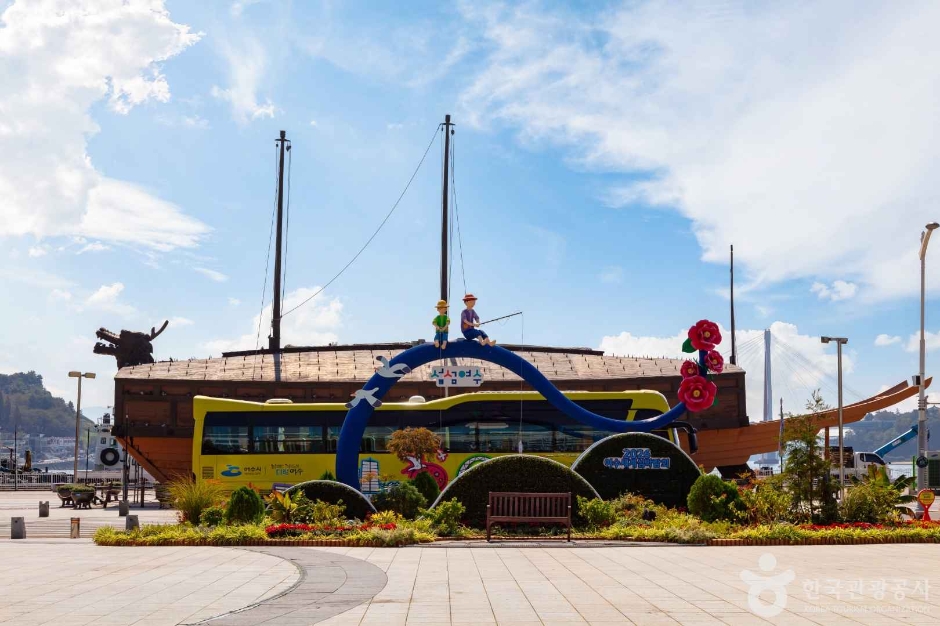


Yi Sun-sin Square in Jungang-dong, Yeosu-si, is a place with many attractions where visitors can see and feel historical sites, including materials about Admiral Yi Sun-sin who led victory in the Imjin War and information about the militia of that time. The square serves as the starting point of a historical and cultural tourism belt connected to nearby historic sites such as Jinnamgwan, where Admiral Yi Sun-sin planned operations and issued military orders. Every May, the oldest patriotic cultural festival in Korea, the Turtle Ship Festival, is held here. The most eye-catching structure is a nearly circular reproduction of the Turtle Ship. It is designed not only as an exterior model but also to be accessible inside. Entering the Turtle Ship interior, visitors can experience the dynamic scenes of naval soldiers and vivid moments of the Imjin War, along with simple interactive activities. Three Turtle Ships were built during the war at Jeollajwasuyeong, Bangdapjin, and Suncheonbu shipyards, with the current location of the Turtle Ship being the site of the Jeollajwasuyeong shipyard. On one side of Yi Sun-sin Square, there is a mural depicting Admiral Yi Sun-sin's life and the course of the Imjin War.
Sohodongdong Bridge 〉


Sohodongdong Bridge is a coastal deck walkway over the sea in Sohodong, where visitors can enjoy the beautiful night view of the night sea. It is 742m long and 3.5m wide. The origin of the name Sohodongdong Bridge is as follows: Since the Goryeo Dynasty, the Yeosu areas Ssangbongdong, Sohodong, and Hakdong were called Jangsaengpo. During the late Goryeo period, when Japanese pirates invaded Jangsaengpo, General Yu Tak went to battle to repel them, causing the pirates to retreat. The soldiers joyfully sang a song called "Jangsaengpogok," and there is a theory that Jangsaengpogok is the same as Dongdong, so the name was finalized as Sohodongdong Bridge. This bridge is a night view spot that is more beautiful at night than in the daytime. After sunset, lights installed on the bridge railings turn on along the coastal deck path, offering a view of the illuminated Seonsodaegyo Bridge. On weekends, busking performances are held and photo zones are set up, making it a great place for a night sea date in Yeosu. At the entrance of Sohodongdong Bridge, the public bicycle rental service "Yeosurang" is available for 1,000 won per day. ◎ Travel information to experience the charm of the Korean Wave - This location was used for filming episode 7 of the drama and is where characters Jinhong and Jinhee had a conversation. Sohodongdong Bridge is a 742m beach walkway and is one of the famous night sea view spots in Yeosu. After sunset, the lights installed along the deck turn on, allowing visitors to enjoy the atmospheric Yeosu night sea.
Day 4
Nangdo 〉
★5.0(1)


The name Nangdo comes from the island's shape resembling a fox, using the character for wolf (狼). However, residents call it Yeosan Village, using the characters for beautiful (麗) and mountain (山) because all the mountains on Nangdo are scenic. Adjacent to it is Sado, famous for the world's longest dinosaur track fossil, and dinosaur footprints can also be found on the rocky shore of Nangdo. The island features low mountains and well-developed coastal trails offering splendid ocean views. It has a safe beach surrounded by wide breakwaters and a nearby campground, creating a natural resort where visitors can enjoy camping and water activities. A representative tourist attraction is Nangdo Beach.
Nangdo Port 〉
★4.1(67)


Nangdo is a small island located between Hwaryang-myeon, Yeosu-si, and Yeongnam-myeon, Goheung-gun. Previously, access to the island was only possible by boat, but after the opening of the land connection and island bridge linking the mainland and the island, accessibility has improved. Nangdo Port is a national fishing harbor that served as an emergency shelter for fishing boats during bad weather and was used as a forward base for fisheries. After the land connection, many tourists visit to buy Nangdo makgeolli, a local specialty, or to enjoy the beautiful nature of Nangdo Port. It is planned to be redeveloped into a tourist area with facilities such as a passenger pier and seafood market.
For this course, these stays make an easy overnight stop
Selected for easy access around the course and strong guest ratings


More recommended itineraries in this city
Travel Reviews
Share your travel tips & promote your social media.
Sign up to feature your channel.
(As a member, you can add your Instagram, YouTube, and blog links in My Page, and we’ll show them with every comment you write.)
- ✔ Your social media links appear with every comment you write.
- ✔ If your comment is chosen as a Best Comment, it’s also featured on our home page with your social media links.
““Stayed near Hongdae and did a night café tour. Perfect city views and vibes.””
Guest comments do not display social media links or profile cards.
Leave a traveler review
Share a short tip about this place.
Or leave a quick comment as a guest.
Drag & drop or click to add images (up to 6)
No reviews yet. Be the first to share your experience!